
Most students stumble across the Helmut Schmidt Programme by accident, a mention in a scholarship Facebook group, a friend who applied years ago, or a late-night search for fully funded Master’s options in Germany. If that’s how you found it, good. You landed in the right place.
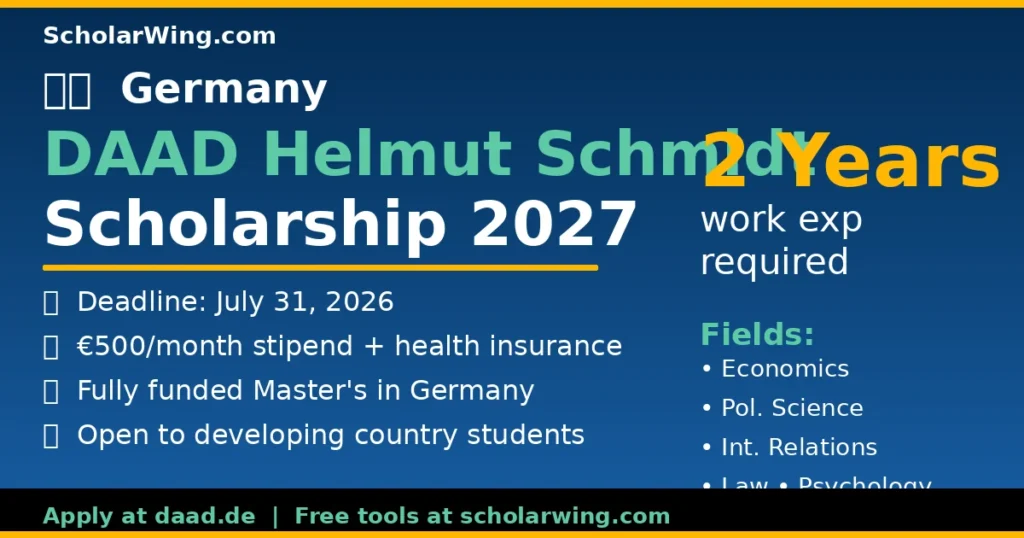
Applications for the 2027/28 academic year are open from June 1 to July 31, 2026. That’s a tight window of just two months. And given that this scholarship targets working professionals from developing countries, a lot of strong applicants miss it simply because they didn’t know it existed or didn’t start preparing in time.
This guide covers everything, what the scholarship actually funds, who qualifies, what the selection committee looks for, and how to put together an application that doesn’t read like it was assembled the night before.
What Is the DAAD Helmut Schmidt Scholarship?
The Helmut Schmidt Program is a fully funded postgraduate scholarship offered by the German Academic Exchange Service (DAAD). It’s named after former German Chancellor Helmut Schmidt, who was known for his strong belief in international cooperation and development.
The programme is specifically designed for students from developing and emerging economies who are pursuing a Master’s degree with a clear connection to governance, development, public policy, law, economics, or social sciences.
What separates it from other DAAD scholarships is its focus on professionals, people already working in government, NGOs, international organizations, or the private sector who want to strengthen their skills and return home to create real impact. It’s not for fresh graduates looking to extend their student years. It’s for people who already have a career and a direction.
What Does the Scholarship Cover?
The Helmut Schmidt Programme is jointly funded by DAAD and the German Federal Ministry for Economic Cooperation and Development (BMZ). Here’s what it provides:
- Monthly stipend of €500 during the fourth semester of the Master’s program
- Full or partial tuition depending on the host university
- Language course support (usually a German preparatory course before studies begin)
- Health insurance coverage during the funding period
- Travel allowance in some cases
One thing to note: the €500 monthly stipend applies specifically to the fourth semester. Many partner universities also provide additional funding during earlier semesters, check directly with your target university’s program page.
The host university for one of the most well-known Helmut Schmidt programs is Hochschule Bonn-Rhein-Sieg (H-BRS) in Germany, which offers a Master’s in International Media Studies in partnership with the Deutsche Welle Akademie (DW Akademie).
Who Can Apply?
The eligibility criteria are specific, and that’s actually good news, it means less competition from generic scholarship hunters.
Basic requirements:
- Citizen of a developing country (check DAAD’s official country list)
- Hold a Bachelor’s degree in a relevant field — typically economics, political science, international relations, development studies, law, or psychology
- Have at least two years of relevant work experience after graduation
- Be applying for a Master’s degree with a development-relevant focus
- Have a clear return commitment — you are expected to go back to your home country and apply what you’ve learned
The work experience requirement is non-negotiable. This is not a scholarship for someone fresh out of university. If you graduated in 2024 and have no work experience, wait until you’ve built a meaningful professional track record before applying.
Language:
- English proficiency is required for English-taught programs
- IELTS 6.0, TOEFL 80+, or a Medium of Instruction (MOI) certificate if your degree was taught in English
- Some programs require basic German — check your specific program’s requirements
Which Programs Fall Under the Helmut Schmidt Scheme?
Several Master’s programs across Germany participate in the Helmut Schmidt Programme. The most prominent include:
- International Media Studies — Hochschule Bonn-Rhein-Sieg / DW Akademie (journalism, media development, communication)
- Development Management — various German universities
- Public Policy and Good Governance — University of Erfurt
- Peace and Conflict Studies — University of Marburg
- International Health — Ludwig Maximilian University Munich
Each program has its own application process and requirements, so always check the specific program page rather than relying solely on the general DAAD portal.
Application Deadline and Timeline
| Stage | Date |
|---|---|
| Applications open | June 1, 2026 |
| Application deadline | July 31, 2026 |
| Selection decision | Spring 2027 |
| Program start | October 2027 |
The July 31 deadline gives you roughly two months from when applications opened. That sounds like enough time, but if you factor in gathering transcripts, getting recommendation letters, writing a strong motivation letter, and preparing a research statement, it goes fast.
Start today if you haven’t already.
What the Selection Committee Actually Looks For
DAAD selection committees read hundreds of applications. Most of them look similar, solid academic records, reasonable work experience, and a motivation letter that says something about “contributing to national development.”
That last part is where most applications lose. Vague language about impact doesn’t work. The committee wants to see:
1. A specific professional track record Not just job titles, but outcomes. What did you actually do? Did you manage a program, implement a policy, publish research, lead a team, secure funding? Be specific.
2. A connection between your work and your proposed study There should be a clear logical thread: “I’ve been doing X for Y years. This Master’s program addresses a specific gap in my knowledge that I need to do X better and at a higher level.”
3. A credible return plan Name an organization. Name a role. Name a project you intend to lead. “I will return and contribute to development” is not a return plan. “I will return to the Ministry of Finance in Nairobi, where I currently serve as a budget analyst, and lead the implementation of results-based budgeting across three counties”, that’s a return plan.
4. A genuine connection to Germany or the host program Why this university? Why DAAD? Why Germany? Generic answers fail here. Name a specific program feature, a professor, a research focus, or a German development partnership that connects to your work.
How to Write a Strong Motivation Letter
The motivation letter is the most important document in your application. A weak letter kills a strong profile. A strong letter can sometimes save a borderline one.
Structure that works:
Paragraph 1: The hook Start with a specific moment from your professional life that explains why you’re applying. Not “I have always been passionate about development.” Open with something real, a policy you tried to implement that failed because of a knowledge gap, a conversation with a community you serve, a problem you’ve been wrestling with for three years.
Paragraph 2: Your background Where have you worked? What have you accomplished? Keep it tight, this isn’t your CV. Pick your two or three most relevant professional achievements and explain why they matter for your study proposal.
Paragraph 3: Why this program Name specific program features, partner organizations, faculty, or research centers that connect to your work. Show that you’ve done your research.
Paragraph 4: Your return plan Be specific. Organization + role + project + timeline. This is where you convince the committee their investment will have real-world impact.
What to avoid:
- Starting with a quote from a famous person
- Using the word “passionate” in your opening sentence
- Generic development language (“I want to give back to my community”)
- Copying phrases from successful examples you found online
Use ScholarWing’s free Motivation Letter Generator to build your first draft, then personalize every paragraph with your specific experience.
Documents You’ll Need
Most Helmut Schmidt programs require:
- ✅ Completed application form (from the specific program portal)
- ✅ Bachelor’s degree certificate and transcripts
- ✅ Proof of work experience (employer letter, contract, or HR letter)
- ✅ Motivation letter (program and scholarship-specific)
- ✅ CV — academic format, 2 pages maximum
- ✅ Two recommendation letters (at least one from a current or recent employer)
- ✅ Language certificate — IELTS/TOEFL or MOI Certificate
- ✅ Passport copy
Note on MOI Certificate: If your degree was taught in English, you can get a free Medium of Instruction Certificate from your university registrar instead of paying for IELTS. DAAD accepts this for most programs. Use ScholarWing’s free MOI Certificate Generator to generate the correct letter format, then get it stamped by your registrar.
Common Mistakes That Get Applications Rejected
1. Applying without relevant work experience Two years of meaningful work is the threshold. Internships and volunteer work alone don’t qualify. If you’re short on experience, this isn’t your cycle.
2. Weak motivation letter Generic language, no specific program connection, vague return plan. This accounts for a majority of rejections among applicants who would otherwise be competitive.
3. Mismatched field The programme targets economics, political science, law, international relations, psychology, and related development fields. Applying with a hard science or engineering background without a clear development angle will struggle.
4. Missing or late documents The July 31 deadline is firm. Request recommendation letters at least three weeks in advance. Don’t assume a professor will turn around a letter in 48 hours.
5. Not contacting the program directly Several Helmut Schmidt programs run their own pre-selection or informational sessions. Email the program coordinator before applying and ask if there are any country-specific guidelines or information sessions.
Frequently Asked Questions
Is DAAD Helmut Schmidt fully funded?
The scholarship covers a monthly stipend of €500 during the fourth semester, health insurance, and often a language course. Tuition coverage varies by host university. It’s not the same as a blanket full scholarship, check your specific program for the complete funding breakdown.
Can fresh graduates apply?
No. The programme requires at least two years of relevant professional experience after completing your Bachelor’s degree.
Is work experience mandatory?
Yes. This is one of the defining features of the Helmut Schmidt Programme. Applicants without professional experience will not be competitive regardless of academic results.
Does DAAD accept MOI Certificate instead of IELTS?
Yes, for most programs. If your undergraduate degree was taught in English, a Medium of Instruction Certificate from your university registrar is accepted.
Can I apply from Pakistan, Nigeria, Bangladesh, or Kenya?
Yes. The scholarship is open to citizens of developing and emerging economy countries. Check DAAD’s official country list at daad.de to confirm your country’s eligibility.
What is the return obligation?
Helmut Schmidt scholars are expected to return to their home country after completing the program and apply their skills in a professional role. This is not just a formality, it’s a core selection criterion.
How competitive is the Helmut Schmidt Programme?
Very. Each program receives far more applications than it has seats. Strong academic record + clear professional trajectory + specific return plan = competitive application. Generic applications fail regardless of GPA.
When will the 2027/28 portal open?
Applications for 2027/28 opened June 1, 2026 and close July 31, 2026.