
PhD and Master’s Scholarships Look Similar on the Outside — They Are Completely Different on the Inside
Most scholarship guides treat PhD and Master’s programs as variations of the same thing. They are not. The documents are different. The evaluation criteria are different. The professor contact requirements are different. The stipends are different. The timelines are different.
A student who applies for a DAAD PhD scholarship the same way they would apply for a DAAD Master’s scholarship, with a study plan instead of a research proposal, without prior contact with a German professor, without publications in their application, will be rejected regardless of their academic quality.
This guide gives you the specific differences across every major dimension that matters, with confirmed 2026 figures for the scholarships ScholarWing readers apply to most.
Stipend Differences — PhD Pays More Everywhere
| Scholarship | Master’s Stipend | PhD Stipend |
|---|---|---|
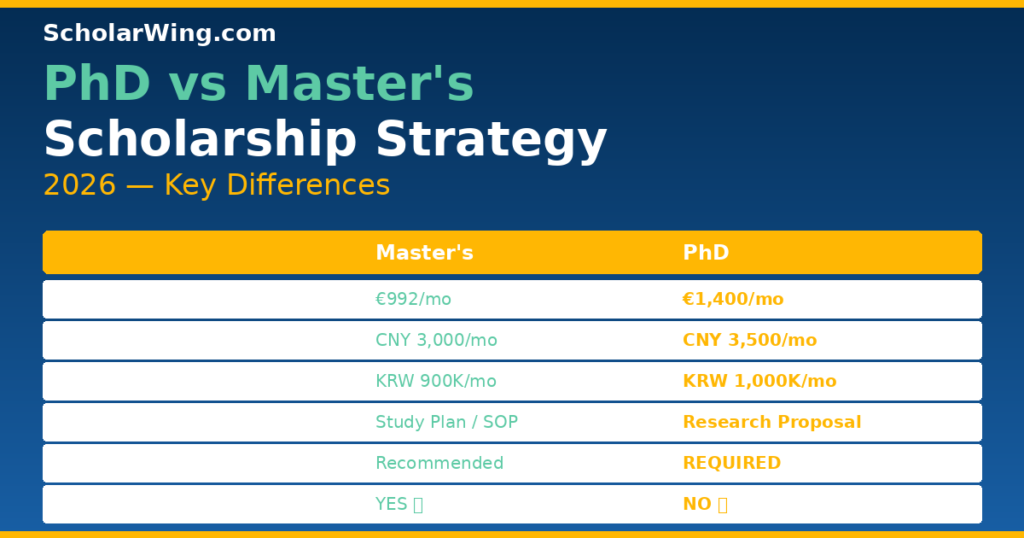
| DAAD | €992/month | €1,300/month (€1,400 from Feb 2026) |
| CSC China | CNY 3,000/month | CNY 3,500/month |
| GKS Korea | KRW 900,000/month | KRW 1,000,000/month |
| Turkiye Burslari | Lower tier | Higher tier |
| MEXT Japan | JPY 143,000/month | JPY 145,000-147,000/month |
In every major scholarship, PhD students receive a higher monthly stipend than Master’s students. This reflects the longer program length, greater research contribution expected, and higher cost of living over a 3-5 year PhD versus a 1-2 year Master’s.
The Critical Document Difference
Master’s: Study Plan or SOP A study plan for a Master’s scholarship explains what you intend to study, why you chose the program, and how it connects to your career goals. It is primarily forward-looking: where you are going and why.
For CSC China Master’s, the study plan is the core document alongside your degree and transcripts. For DAAD Master’s (Study Scholarship), your motivation letter and description of the study project together function as the study plan. The study plan is explicitly required and typically 2-3 pages for GKS Korea.
PhD: Research Proposal A research proposal is an entirely different document type. It defines your research question, reviews existing literature to establish the gap your research addresses, describes your methodology, explains your data collection or experimental approach, outlines a realistic timeline, and justifies why your chosen institution and supervisor are the right fit.
DAAD’s requirements are explicit: a research proposal is an extensive and detailed description of the research project discussed with your academic supervisor, maximum 10 pages. It must address: the research field and current state of literature, theoretical framework and why competing frameworks are not used, data collection methodology, and feasibility timeline.
This is a document that takes weeks to write, requires genuine research expertise, and must be discussed with a supervisor before submission. It cannot be written the week before the application deadline.
For CSC China PhD: a research proposal and supervisor acceptance letter are essential. A proposal that could apply to any university or any field is the most common rejection reason for PhD applications.
Use ScholarWing’s free Research Proposal Generator to structure your proposal
Professor Contact — Required for PhD, Recommended for Master’s
This is the most significant practical difference between PhD and Master’s applications.
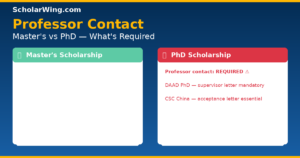
For Master’s scholarships: Professor contact is helpful but not required for most programs. DAAD Master’s Study Scholarship applicants select their program and university through the application process — no prior professor contact is necessary. CSC China Master’s applicants benefit from a supervisor contact letter but can apply without one through the Embassy (Type A) route.
For PhD scholarships: Professor contact is essential — and in many cases, the application literally cannot proceed without it.
DAAD PhD: The research proposal “has been discussed with the academic adviser”, this language in the official guidelines means you must have an established supervisor relationship before submitting. Additionally, the application requires a “letter confirming supervision by the doctoral supervisor” uploaded to the portal. Without this letter, your PhD application is incomplete.
CSC China PhD: Securing an acceptance letter from a CSU professor is mandatory for some programs. For others, a supervisor contact letter significantly improves selection chances and is expected by most top-ranked Chinese universities offering PhD positions.
How to contact professors for PhD:
- Find 3-5 professors whose recent (last 2-3 years) published research directly aligns with your proposal
- Read their most recent paper
- Write a 200-300 word email explaining your research background, what you read, and asking whether they could supervise
- Attach a 1-page research summary
- Follow up once after 2 weeks
- Start this process 4-6 months before your application deadline
Selection Criteria Differences
Master’s selection: Academic qualifications (GPA, degree quality), quality and feasibility of the study project, motivation and career prospects. Leadership and development impact are weighted more heavily in programs like DAAD EPOS and Chevening.
PhD selection: Academic qualifications remain important, but research proposal quality takes center stage. DAAD’s published PhD selection criteria explicitly lists: quality of research proposal (originality, topicality, relevance, choice of host institution, first contacts); feasibility of work plan and timetable; embedding of the project in the overall doctoral project. The quality of your existing publications or research outputs also becomes a significant factor that doesn’t exist for most Master’s applications.
Timeline and Age Limit Differences
CSC China:
- Master’s: under 35 years old
- PhD: under 40 years old
DAAD:
- No age limit — the 6-year rule (degree not older than 6 years) applies to both
- PhD programs can extend 3-5 years — factor this into your return plan writing
GKS Korea:
- General track: under 40 for both (varies by specific program)
Chevening:
- Master’s only — Chevening does not fund PhD programs
Which Programs Are PhD-Only vs Master’s-Only
PhD-only programs:
- DAAD Research Grants for Doctoral Candidates
- DAAD Research Stays for foreign PhD students in Germany
- Some specific university-funded PhD positions
Master’s-only programs:
- Chevening — explicitly states it does not fund doctoral programs
- Stipendium Hungaricum (primarily Master’s)
- Most Erasmus Mundus Joint Master’s Degrees (by definition)
Both PhD and Master’s:
- DAAD Study Scholarship (Master’s) and Research Grant (PhD) — separate applications
- CSC China — both available with different stipends
- GKS Korea — both available
- Turkiye Burslari — both available
- MEXT Japan — both available
Practical Tips by Level
If applying for Master’s:
- Focus your SOP on career goals, program fit, and return impact
- Professor contact is a bonus, not a requirement for most programs
- Leadership and professional experience evidence matters for DAAD EPOS and Chevening
- Apply broadly — Master’s scholarship applications are generally more portable across programs
If applying for PhD:
- Begin contacting potential supervisors 4-6 months before the deadline
- Your research proposal is the heart of your application — invest weeks in it
- Publications or conference papers, even minor ones, significantly strengthen your profile
- Your SOP/motivation letter should explain your research trajectory, not just your career goals
FAQ
Which pays more — a PhD or Master’s scholarship?
PhD stipends are consistently higher across all major scholarships. DAAD PhD pays €1,400/month vs €992 for Master’s. CSC China PhD pays CNY 3,500/month vs CNY 3,000 for Master’s.
Do I need to contact a professor before applying for a PhD scholarship?
Yes, for DAAD and most CSC China PhD applications. DAAD requires a letter confirming supervision from your doctoral supervisor as part of the application package.
Can I apply for a PhD scholarship without publications?
Yes, publications are not a hard requirement for most PhD scholarships. But having at least one published or under-review paper substantially strengthens your application, particularly for DAAD research grants.
Does Chevening fund PhD programs?
No, Chevening is explicitly a Master’s scholarship. It does not fund doctoral programs.
How long is a research proposal for DAAD PhD?
DAAD specifies a maximum of 10 pages for the research proposal, which must be developed in discussion with your academic supervisor.