
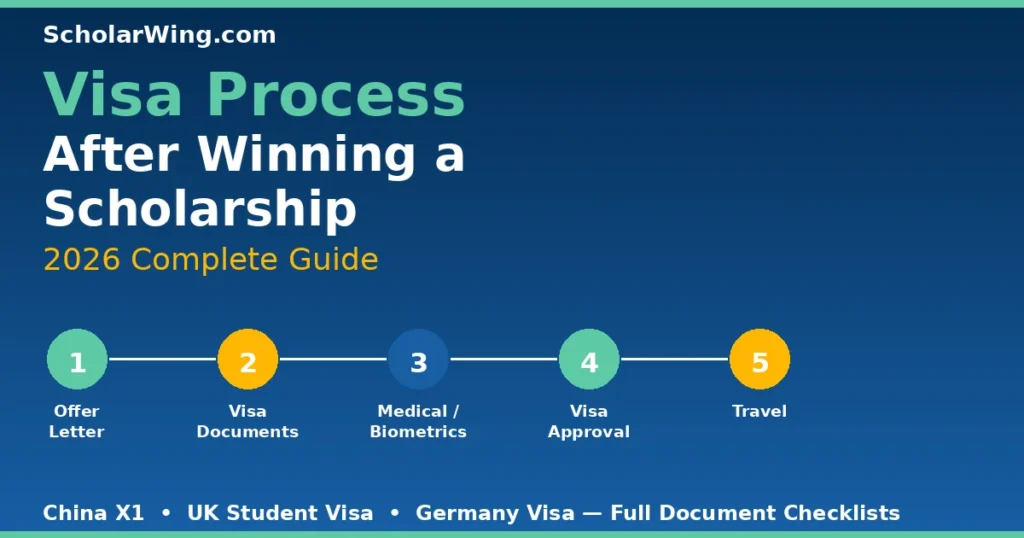
Winning the Scholarship Is Only Half the Process
Every year, students who fought hard to win a fully funded scholarship lose months, sometimes the entire intake, because they treated the visa application as a formality instead of a process with its own deadlines, documents, and rejection risks.
The scholarship offer letter does not guarantee a visa. It is the starting point for a separate, parallel process that has its own requirements, its own paperwork, and its own ways to go wrong. This guide walks through what happens after you win, specifically for China (CSC), the UK (Chevening), and Germany (DAAD), the three most common destinations for ScholarWing readers, plus a general framework that applies to almost every other country.
The General Visa Timeline After Any Scholarship
Regardless of destination country, the process after receiving your scholarship offer follows roughly the same structure:
- Receive your official offer/admission letter — this is the document every visa application requires
- Receive the visa support document specific to your country (JW201/JW202 for China, CAS for UK, visa confirmation letter for Germany)
- Complete required medical examinations (mandatory for China, sometimes required elsewhere)
- Gather financial proof documents — even with full funding, most visas require proof of funds
- Obtain police clearance certificate — required by China and several other countries
- Submit visa application through the relevant portal or visa application center
- Attend biometrics appointment and/or interview if required
- Receive visa decision — processing times vary from 5 days to 8 weeks depending on the country
- Travel and register on arrival — many countries require police or address registration within 24-72 hours of arrival
Start this process the moment you receive your offer letter, not after your scholarship stipend starts, and not “whenever there’s time.” Visa processing has hard deadlines tied to your program start date.
China X1 Student Visa — Complete Process for CSC Scholarship Winners
China requires the most documentation of any major scholarship destination, but the process is well-defined and predictable if you follow it step by step.
Important: China’s visa-free entry policy does not apply to ordinary Pakistani passport holders or most other developing country passport holders, only diplomatic and official passports are exempt. Every CSC scholarship winner needs an X1 visa regardless of nationality exemptions for tourism.
Step 1: Receive your JW201 Form CSC scholarship winners receive the JW201 form, the official visa support document issued by the Chinese Ministry of Education specifically for government scholarship holders. Your university’s international office sends this along with your Admission Notice. Self-funded students receive the JW202 form instead.
This document is printed on official security paper and cannot be reproduced. If lost, the university must request a replacement from the provincial education bureau — a process that takes 2-4 weeks. Keep multiple physical copies and a scanned backup immediately.
Step 2: Complete the Medical Examination China requires a medical exam for all X1 visa applicants, this is mandatory, not optional. You need the Foreigner Physical Examination Form, available from your university’s website or the Chinese embassy. The exam must be conducted at a clinic or hospital recognized by the Chinese embassy, not just any hospital.
The exam typically includes blood tests, a chest X-ray, and a general physical examination. Book this early, recognized clinics have limited appointment slots, especially during peak intake months (June-August).
3: Obtain Your Police Clearance Certificate (PCC) A clean criminal record certificate is required. Pakistani students can obtain this via Police Khidmat Markaz or the ICTP app. Processing typically takes 1-2 weeks.
Additional:
Important 2026-27 update for Pakistani applicants: As of the Islamabad Chinese visa center’s current process, a PCC with a QR code does not require apostille certification, this significantly simplifies the document chain. Check current requirements at your local visa application center, as this can change.
Step 4: Prepare Your Document Set
- Valid passport (minimum 6 months validity, blank visa pages)
- JW201 form (original, security paper)
- Admission Notice from your Chinese university
- Foreigner Physical Examination Form (completed)
- Police Clearance Certificate
- Passport-size photographs (per Chinese visa specifications)
- Academic documents (Matric, Intermediate, Bachelor’s, transcripts — attested where required)
CSC scholarship holders typically do NOT need to show bank statements — the scholarship documentation itself serves as proof of funding. This is a meaningful simplification compared to self-funded applicants.
5: Apply Through COVA and the Visa Application Center Complete the visa application form online via COVA (China’s online visa application system), then submit your physical documents at the Chinese Visa Application Service Center in your country. Some applicants may be invited for a visa interview to discuss study plans.
Step 6: After Arrival — Register and Convert to Residence Permit The X1 visa itself is a single/limited entry document. After arriving in China, you must convert it to a residence permit at the local Public Security Bureau (PSB) within 30 days, this requires another medical exam (if your original exam is older than 6 months) at a cost of approximately RMB 622, plus your accommodation registration.
All foreigners must register their accommodation at the local police station within 24 hours of arrival or any address change. University dormitories typically handle this automatically; off-campus students must visit the police station with their landlord.
UK Student Visa — Process for Chevening Scholars
Chevening scholars apply for the UK Student Route visa (formerly Tier 4) through a process the Chevening Secretariat actively guides you through, but the visa application itself is your responsibility through UK Visas and Immigration (UKVI).
Step 1: Receive Your CAS (Confirmation of Acceptance for Studies) Your UK university issues a CAS number once you have an unconditional offer and have confirmed your place. This is the core document your visa application is built around, equivalent to China’s JW201/JW202.
Step 2: Check Your Passport Validity Your passport should be valid for the full duration of your scholarship. If it’s due to expire during your study period, renew it before applying, a passport renewal mid-program creates complications.
3: Gather Financial Documents Even as a fully funded Chevening scholar, you will need to provide evidence of your funding arrangement as proof you can support yourself, though Chevening’s funding letter typically satisfies this requirement directly, removing the need for personal bank statements that self-funded students must show.
Additional:
For self-funded UK students generally: funds can come from savings, loans, or scholarships, but the 28-day rule applies strictly, funds must have been held in your account for at least 28 consecutive days before application. Blocked accounts or fixed deposits are accepted if accessible.
4: Complete the Online Application Apply online through the UK government’s official visa portal. Complete all sections fully, honestly, and accurately, providing evidence in the exact format required by UKVI.
5: Book Biometrics Appointment You will need to attend a biometrics appointment at a Visa Application Centre. If there’s no visa application centre in your home country, you may need to travel to a neighbouring country for this appointment, plan for this possibility and the associated cost and timeline in advance.
Step 6: Pay the Immigration Health Surcharge (IHS) and Visa Fee The IHS gives you access to the UK’s National Health Service for your study duration. This is a substantial cost, calculate it based on your program length and budget for it even with scholarship funding, as reimbursement timing varies.
Processing time: Standard UK student visa processing from Pakistan typically takes 3-8 weeks, though this varies by season. Apply as early as your CAS allows, don’t wait until close to your program start date.
Germany Visa — Process for DAAD Scholars
DAAD scholarships are typically pre-admission scholarships, meaning you apply for DAAD funding first, and your university program admission and visa process happen afterward. This is different from China and the UK, where admission usually precedes or coincides with the scholarship decision.
Step 1: Accept Your DAAD Scholarship Offer After interview and selection, you officially accept the scholarship offer. DAAD then supports your university application process if you don’t already have a confirmed program.
Step 2: Secure University Admission If you don’t already have a place at a German university, DAAD scholars work through this with DAAD’s support, find a program that matches your scholarship category and field.
3: Calculate and Prove Your Financial Requirement German visa rules require proof of at least EUR 11,904 annually (approximately EUR 992/month) for living costs. This is not a recommendation, it is a mandatory visa requirement, and without proof at this level, your visa application is rejected regardless of your academic qualifications.
Additional:
For DAAD scholars specifically: your DAAD funding letter, confirming the monthly stipend (EUR 850-992/month depending on program), typically satisfies this financial requirement directly, since it meets or exceeds the minimum threshold.
4: Book Your Visa Appointment Visit the German Embassy or consulate website in your country to book your student visa appointment. German embassy appointment slots can have significant waiting periods, especially during peak intake season (June-September), book the moment you have your university admission and DAAD confirmation in hand.
5: Prepare Required Documents
- Valid passport
- University admission letter
- DAAD scholarship confirmation letter (this serves as financial proof)
- Health insurance confirmation (DAAD scholars typically receive this through their scholarship)
- Academic transcripts and certificates
- Biometric photographs per German visa specifications
- Proof of German language proficiency (if applicable) or English program confirmation
6: Attend Your Visa Interview German student visa applications typically include an in-person interview at the consulate to confirm your study plans and intentions.
Step 7: Arrival Registration After arriving in Germany, register your address (Anmeldung) at the local registration office within the first 1-2 weeks — this is required before you can open a bank account, get a residence permit, or access many services.
Common Reasons Visa Applications Get Rejected
Across China, UK, Germany, and most other scholarship destinations, certain mistakes recur constantly. Avoid these:
1. Fake or inflated bank statements Even with a scholarship, some applicants try to inflate personal financial documents “just to be safe.” This is a serious mistake — visa officers cross-check financial documents and discrepancies can lead to rejection or even future visa bans. Use your genuine scholarship documentation; do not supplement it with fabricated personal funds.
2. Incomplete or incorrect visa support documents Submitting a JW202 form when you should have a JW201 (or vice versa), or submitting an expired CAS number, are avoidable administrative errors that cause automatic rejection or delay.
3. Missing the medical examination window China requires medical exams at officially recognized clinics, exams done at the wrong facility are not accepted and must be redone, costing time and money. Always confirm your clinic is on the embassy’s approved list before booking.
4. Passport validity issues A passport that expires during your study period, or doesn’t have enough blank visa pages, causes rejection. Check this before you even start your visa application, renew early if needed.
5. Inconsistent information across documents Your name spelling, date of birth, and other personal details must match exactly across your passport, academic documents, scholarship letter, and visa application. Even minor discrepancies (a missing middle name, different date formats) can trigger delays or rejection.
6. Applying too late Visa processing has its own timeline separate from your scholarship’s timeline. A scholarship offer received in May for a September program start gives you roughly 3-4 months, tight but workable if you start immediately. Waiting until July compresses this dangerously.
Quick Reference: Visa Documents by Destination
| Document | China (X1) | UK (Student) | Germany |
|---|---|---|---|
| Visa support document | JW201 (CSC) / JW202 | CAS number | University admission + DAAD letter |
| Financial proof | Not required for CSC scholars | Scholarship letter / bank statements | EUR 11,904/year proof |
| Medical exam | Mandatory | Not typically required | Not typically required |
| Police clearance | Required | Not typically required | Not typically required |
| Biometrics | Required | Required | Required |
| Interview | Sometimes | Not typically | Often required |
| Processing time | 2-4 weeks | 3-8 weeks | 4-8 weeks (book early) |
Practical Tips for a Smooth Visa Process
1. Start the moment you receive your offer letter Don’t wait for your scholarship stipend to start arriving. The visa process timeline runs independently and often takes longer than students expect.
2. Keep physical and digital copies of everything Security-paper documents like China’s JW201 cannot be easily replaced. Scan everything the moment you receive it and store copies in multiple places (cloud storage, email to yourself, printed backup).
3. Don’t submit financial documents that don’t match your actual situation If you have a scholarship, lead with the scholarship documentation. Adding extra personal financial documents that look inflated or unusual draws more scrutiny, not less.
4. Book medical exams and biometrics appointments immediately These have limited availability, especially during peak intake season (June-September for most Northern Hemisphere programs). Book the day you’re eligible to do so.
5. Double-check every name and date across all documents Before submitting anything, compare your passport, academic certificates, scholarship letter, and visa application form side by side. Fix any discrepancy before submission, not after rejection.
6. Keep your university’s international office in the loop Most universities have dedicated staff to help scholarship students through the visa process. Use this resource, they have seen every type of complication before.
FAQ
Do I need a visa if I receive a fully funded scholarship?
Yes, a scholarship is not a visa. You still need to apply for a student visa separately, even though your scholarship significantly simplifies the financial proof component of that application.
Does China require a medical exam for the X1 visa?
Yes, this is mandatory for all X1 visa applicants. The exam must be done at a clinic or hospital recognized by the Chinese embassy, and includes blood tests, a chest X-ray, and a general health check.
Do CSC scholarship holders need to show bank statements for the China visa?
Typically no, your scholarship documentation (JW201 form and Admission Notice) serves as your funding proof. This removes a significant document burden compared to self-funded applicants.
How long does the UK Student visa take for Chevening scholars?
Standard processing from Pakistan and most countries typically takes 3-8 weeks. Apply as soon as your CAS number is issued, don’t wait.
What is the minimum financial proof required for a German student visa?
EUR 11,904 annually (approximately EUR 992/month), this is a mandatory requirement, not a guideline. DAAD scholarship funding typically meets this threshold and serves as your proof.
What happens if my visa support document (JW201/CAS) is lost or expires?
For China’s JW201, your university must request a replacement from the provincial education bureau, which takes 2-4 weeks. For UK’s CAS, contact your university immediately, CAS numbers can expire and need reissuing if your visa application is delayed.
Do I need to register with police after arriving in my study destination?
In China, yes, within 24 hours of arrival, typically handled automatically by university dormitories. In Germany, you must complete address registration (Anmeldung) within 1-2 weeks of arrival. The UK does not require general police registration for most student visa holders.