
Winning a scholarship is step one.
Getting your student visa approved is step two — and it trips up more students than most people realize.
Visa rejections happen for predictable, avoidable reasons: missing documents, insufficient financial proof, unclear travel history, or applications submitted too late. None of these reasons are academic. All of them are preventable with the right preparation.
This guide covers the student visa process for the six most common scholarship destinations — Germany, the UK, the USA, Japan, South Korea, and Australia. For each country, you will find the exact documents required, the process, timelines, and the most common reasons for rejection.
Before You Apply for Any Student Visa
Regardless of which country you are heading to, three things must be done before you touch a visa application:
1. Receive your official admission letter Every country requires an unconditional offer letter from an accredited institution before they will process a student visa. Don’t apply for a visa until this is confirmed in writing.
2. Sort your financial proof Every country wants evidence that you can support yourself during your studies. The exact requirement varies — but the principle is the same. Know the requirement for your destination country and prepare it early.
3. Book your biometrics appointment early In many countries, biometrics appointments at embassies or visa application centers are booked weeks in advance. In busy periods (August–October), slots can fill up 4–6 weeks out. Book immediately after gathering your documents — not after.
Student Visa Application Guide 2026:
Germany Student Visa 🇩🇪

Germany issues a National Visa (Type D) for students staying longer than 90 days. This visa is applied for at the German Embassy or Consulate in your home country.
Documents Required:
- ✅ Valid passport (minimum 12 months validity beyond program end)
- ✅ Completed visa application form (downloaded from German Embassy website)
- ✅ University admission letter (Zulassungsbescheid)
- ✅ Blocked account (Sperrkonto) — €11,208 deposited with Fintiba, Expatrio, or Deutsche Bank
- ✅ Health insurance proof (valid from arrival date)
- ✅ Biometric passport photos (35mm × 45mm, white background)
- ✅ CV / Resume
- ✅ Academic transcripts and degree certificates (certified copies)
- ✅ APS Certificate (mandatory for Pakistani, Indian, and Chinese applicants)
- ✅ Proof of accommodation in Germany (university dorm confirmation or rental agreement)
- ✅ Language certificate (IELTS/TOEFL for English programs; TestDaF/DSH for German programs)
📑 Need a scholarship CV? Build one free with our CV Builder — 3 templates, PDF & Word download.
Process:
- Open a German blocked account (Sperrkonto) — takes 3–7 business days online with Fintiba or Expatrio
- Purchase health insurance valid from your arrival date
- Book a visa appointment at the German Embassy (book early — slots fill up fast)
- Attend the appointment with all original documents
- Pay the visa fee (approximately €75)
- Wait for processing — typically 4–12 weeks
Timeline:
Start the visa process at least 3–4 months before your program start date.
Most Common Rejection Reasons:
- Blocked account not opened or insufficient amount
- APS Certificate missing (for Pakistani, Indian, Chinese students)
- Accommodation proof missing
- Health insurance not valid from arrival date
After Arrival:
Within 14 days of arriving in Germany, register your address at the local Einwohnermeldeamt (residents’ registration office). This is legally mandatory and required for opening a bank account, getting a SIM card, and everything else.
UK Student Visa (Tier 4 / Student Route) 🇬🇧
The UK issues a Student Visa (formerly Tier 4) for international students studying a full-time course longer than 6 months.
Documents Required:
- ✅ Valid passport
- ✅ Confirmation of Acceptance for Studies (CAS) number — issued by your UK university
- ✅ Proof of financial funds:
- Tuition fees not yet paid + £1,334/month for living costs (London) or £1,023/month (outside London) for the duration of your course (up to 9 months)
- For scholarship students: official scholarship award letter confirming financial coverage
- ✅ English language certificate (IELTS, TOEFL, or equivalent — must be from UKVI-approved test centers)
- ✅ Tuberculosis (TB) test results (required for applicants from Pakistan, India, Bangladesh, and several other countries)
- ✅ Parental consent letter (if under 18)
- ✅ Academic transcripts (for some applicants)
📖 Preparing for IELTS or TOEFL? Try our Free Practice Tests — Reading, Writing, Vocabulary, Grammar and Speaking.
Process:
- Receive your CAS number from your UK university — this can only be issued after you accept your offer
- Apply online through the UK Visas and Immigration (UKVI) portal
- Pay the visa fee (approximately £490) and Immigration Health Surcharge (£776/year — waived for scholarship students at some institutions)
- Book and attend a biometrics appointment at a Visa Application Centre
- Submit your passport and biometrics
- Wait for a decision — typically 3 weeks
Timeline:
Apply no earlier than 6 months before your course start date. Apply at least 6–8 weeks before you need to travel.
Important for Scholarship Students:
Chevening, Commonwealth, and other UK government scholarship award letters are accepted as proof of financial support. You do not need to show personal bank statements if your scholarship covers full living costs.
Most Common Rejection Reasons:
- IELTS taken at a non-UKVI approved test center
- TB test not completed (many applicants from South Asia forget this)
- Financial proof insufficient or unclear
- CAS number expired or not accepted
USA Student Visa (F-1) 🇺🇸
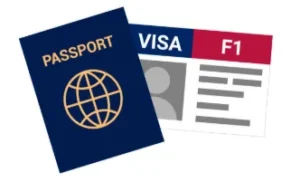
US student visas are called F-1 visas. They are issued by the US Embassy or Consulate in your home country.
Documents Required:
- ✅ Valid passport (minimum 6 months validity beyond intended stay)
- ✅ Form I-20 — issued by your US university after admission (essential — without this, no F-1 visa)
- ✅ DS-160 online visa application form (completed at ceac.state.gov)
- ✅ SEVIS fee payment receipt (Form I-901) — approximately $350
- ✅ Visa application fee payment — approximately $185 (MRV fee)
- ✅ Proof of financial support:
- Bank statements showing sufficient funds for first year of study + living costs
- For Fulbright students: Fulbright award letter is sufficient
- ✅ Academic transcripts and degree certificates
- ✅ English language test score (TOEFL or IELTS)
- ✅ Biometric passport photos
📖 Preparing for IELTS or TOEFL? Try our Free Practice Tests — Reading, Writing, Vocabulary, Grammar and Speaking.
Process:
- Receive Form I-20 from your US university
- Pay the SEVIS fee online at fmjfee.com
- Complete the DS-160 form online
- Pay the MRV visa application fee
- Schedule a visa interview appointment at the US Embassy
- Attend the interview — bring all original documents
- Receive a decision — usually on the same day or within a few days
The F-1 Visa Interview:
Unlike most countries, the USA conducts a face-to-face visa interview for almost all F-1 applicants. The officer will ask questions about:
- Your study plans and intended program
- How you will fund your studies
- Your ties to your home country (why you will return)
- Your career plans after graduation
Key tip: Be honest, direct, and clear. The officer wants to know that you are a genuine student who will return home after your studies. Demonstrating strong ties to your home country — family, job offers, career plans — is critical.
Timeline:
Apply for your F-1 visa at least 3–4 months before your program start date. Peak periods (June–August) can see appointment waiting times of 6–8 weeks.
Most Common Rejection Reasons:
- Insufficient proof of financial support
- Unclear ties to home country
- Inconsistent answers during the interview
- SEVIS fee not paid before the interview
Japan Student Visa 🇯🇵

Japan issues a College Student Visa (留学ビザ) for international students. For MEXT scholarship students, the process is partially managed by the Japanese Embassy.
Documents Required:
- ✅ Valid passport
- ✅ Certificate of Eligibility (COE) — issued by the Japanese Immigration Services Agency through your university in Japan. This is the most important document.
- ✅ Visa application form (downloaded from Japanese Embassy website)
- ✅ Passport-size photo (4cm × 3cm, white background, recent)
- ✅ University admission letter
- ✅ Proof of financial support (bank statements or scholarship award letter)
- ✅ Academic transcripts
Process:
- Your Japanese university applies for a Certificate of Eligibility (COE) on your behalf — this takes 1–3 months
- Once the COE arrives (usually mailed to you), apply for the visa at the Japanese Embassy in your country
- Submit documents and pay the visa fee (typically free or very low cost)
- Receive your visa within 5–7 business days
For MEXT Scholarship Students:
The Japanese Embassy manages much of the visa process for MEXT scholars. Follow their specific instructions — they will contact you directly after the scholarship is confirmed.
Timeline:
The COE process takes 1–3 months. Factor this into your planning — start the visa process as soon as you receive your Japanese university admission.
South Korea Student Visa (D-2) 🇰🇷
South Korea issues a D-2 Student Visa for international students enrolled in degree programs.
Documents Required:
- ✅ Valid passport
- ✅ Visa application form (completed online or at Korean Embassy)
- ✅ University admission letter from a Korean institution
- ✅ Proof of financial support:
- Bank statement showing minimum KRW 3,000,000 (approximately $2,200 USD)
- For GKS scholars: GKS award letter is accepted
- ✅ Academic transcripts and degree certificates
- ✅ Passport-size photos (3.5cm × 4.5cm)
- ✅ Standard visa fee (approximately $60 USD — varies by nationality)
- ✅ Health certificate (some nationalities required)
Process:
- Receive admission letter from your Korean university
- Prepare all documents
- Apply at the Korean Embassy or Consulate in your home country
- Pay the visa fee
- Receive the visa within 3–10 business days
For GKS Scholarship Students:
GKS provides specific visa guidance to selected scholars. Your GKS award letter replaces personal financial proof. Follow the instructions provided by your Korean university and the Korean Embassy.
Timeline:
Apply at least 4–6 weeks before your program start date.
Australia Student Visa (Subclass 500) 🇦🇺
Australia’s student visa is called Subclass 500. It is applied for entirely online through the Australian Department of Home Affairs.
Documents Required:
- ✅ Valid passport
- ✅ Confirmation of Enrolment (CoE) — issued by your Australian university
- ✅ Genuine Temporary Entrant (GTE) statement — a written statement explaining why you want to study in Australia and your intention to return home
- ✅ Proof of financial capacity:
- AUD $21,041/year for living costs + tuition fees
- For Australia Awards scholars: award letter covering all expenses
- ✅ English language test results (IELTS 5.5+ minimum for visa; scholarship requires 6.5)
- ✅ Health insurance — Overseas Student Health Cover (OSHC) — mandatory, must be purchased before visa is granted
- ✅ Health examination (requested by the Department of Home Affairs — not always required but be prepared)
- ✅ Character clearance (police clearance certificate from your home country if requested)
- ✅ Academic transcripts
📖 Preparing for IELTS or TOEFL? Try our Free Practice Tests — Reading, Writing, Vocabulary, Grammar and Speaking.
Process:
- Accept your Australian university offer and receive your CoE
- Purchase OSHC health insurance (your university can arrange this)
- Create an ImmiAccount at immi.homeaffairs.gov.au
- Complete the online visa application
- Upload all documents
- Pay the visa application fee (approximately AUD $650)
- Complete health examination if requested
- Receive a decision — typically 4–6 weeks (can be faster or slower)
The GTE Statement:
Australia takes the Genuine Temporary Entrant requirement seriously. Your statement should explain:
- Why you chose this specific course and university
- How it connects to your career goals
- Your ties to your home country and why you will return
- Your previous study and work history
Weak or vague GTE statements are a common reason for visa delays and refusals.
Timeline:
Apply at least 2–3 months before your course start date. For Australia Awards scholars, the scholarship program provides specific guidance on the visa process.
Visa Document Comparison — All Countries
| Requirement | Germany | UK | USA | Japan | Korea | Australia |
|---|---|---|---|---|---|---|
| Admission Letter | ✅ | ✅ (CAS) | ✅ (I-20) | ✅ (COE) | ✅ | ✅ (CoE) |
| Financial Proof | Blocked account | Bank/Scholarship | Bank/Scholarship | Bank/Scholarship | Bank/Scholarship | Bank/Scholarship |
| Health Insurance | ✅ | Health Surcharge | Through university | ✅ | Sometimes | OSHC mandatory |
| Biometrics | ✅ | ✅ | ✅ | ❌ | ❌ | ✅ (sometimes) |
| Interview | ❌ | ❌ | ✅ (mandatory) | ❌ | ❌ | ❌ |
| TB Test | ❌ | ✅ (South Asia) | Sometimes | ❌ | ❌ | Sometimes |
| APS Certificate | ✅ (Pak/India/China) | ❌ | ❌ | ❌ | ❌ | ❌ |
| Typical Processing | 4–12 weeks | 3 weeks | 1–4 weeks | 5–7 days (after COE) | 3–10 days | 4–6 weeks |
General Tips That Apply to Every Visa
Start early — always. Visa delays cause students to miss enrollment deadlines every year. The 6–8 week processing estimate is a guideline, not a guarantee.
Use official sources only. Visa requirements change. Always verify the current requirements directly on the official Embassy website — not blogs, Facebook groups, or forums.
Original documents matter. Bring originals to every appointment, even if the application only asks for copies. Officers sometimes ask to see originals.
Never submit false documents. A visa rejection for document fraud creates a permanent record that can affect future applications to that country and others.
For scholarship students — carry your award letter everywhere. It replaces personal financial proof at most embassies and should be part of every document set you prepare.
FAQ — Student Visa Applications
Q: Can I apply for a student visa before I have my scholarship confirmation?
For most countries — no. You need both an admission letter and financial proof (which the scholarship letter provides) before the visa process can begin properly.
Q: What happens if my visa is rejected?
You can usually reapply. Request a written reason for the rejection from the Embassy, address the specific issue, and reapply with a stronger application. Contact your scholarship program immediately — they may have experience handling visa issues.
Q: Can I travel to other countries before my studies start?
Usually yes — but check the entry conditions of your student visa. Some visas specify earliest entry dates. The USA F-1, for example, allows entry no more than 30 days before your program start date.
Q: Do I need to speak the local language for a visa interview?
For the USA F-1 interview, the interview is in English. For other countries that do not require interviews, language is not an issue at the visa stage.
Q: Can my family come with me on a student visa?
Some countries allow dependents — spouses and children — on dependent visas linked to your student visa. Germany, UK, and Australia all have dependent visa pathways. Requirements and financial thresholds are higher for dependent applications. Check the specific rules for your destination country.
Q: My visa was approved but the dates are wrong — what do I do?
Contact the Embassy immediately. Do not travel on a visa with incorrect dates — it can create serious immigration issues.
Final Checklist Before You Travel
- ✅ Visa approved and dates correct
- ✅ Passport valid for full duration of stay
- ✅ Accommodation confirmed and address saved
- ✅ Health insurance active from arrival date
- ✅ Emergency contact numbers saved (Embassy, university international office, scholarship coordinator)
- ✅ Financial access sorted (international card or local account arranged)
- ✅ Copies of all documents — physical and digital
- ✅ Scholarship coordinator informed of your travel dates
Winning your scholarship and getting your visa are both steps toward the same goal. The process takes patience and careful preparation — but it is entirely manageable when you know exactly what is needed.
Use our Deadlines Calendar to track visa and scholarship deadlines together, and our Document Checklist to make sure your full application package is complete.
👉 Browse All Scholarships 👉 Document Checklist by Country 👉 Check Your Eligibility 👉 View All Deadlines 👉 Study in Germany Free — Complete Guide