
Multiple Rejections Don’t Mean You’re Unqualified — They Mean Something Needs to Change
Every year, students who are genuinely capable of winning major scholarships get rejected. Some get rejected once and succeed the following cycle, some get rejected two or three times before winning. And Some are applying with a fundamentally incorrect approach and will keep getting rejected until something structural changes.
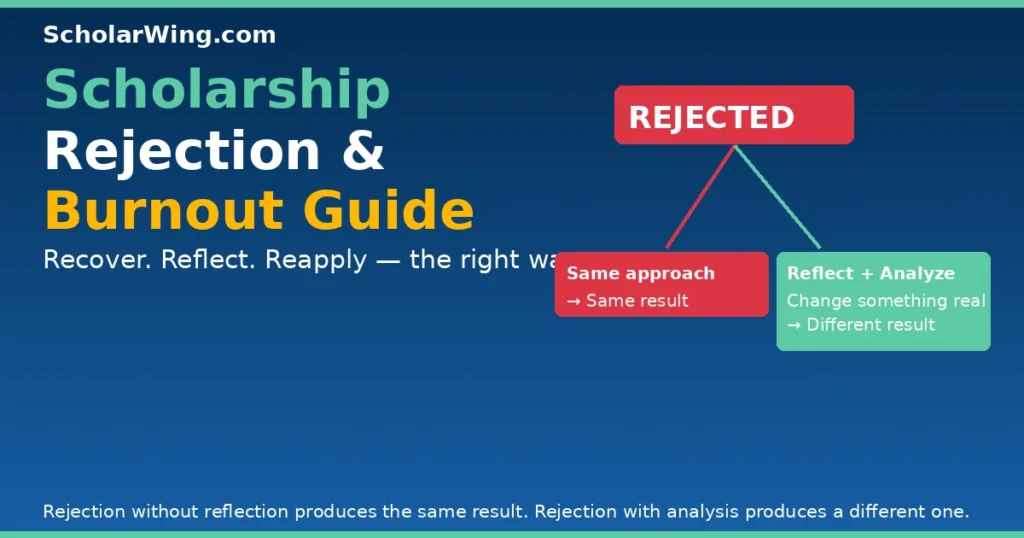
The emotional experience of these three situations feels identical from the inside. That’s the problem. Rejection without reflection produces the same result every time. But rejection followed by honest, specific analysis of what the committee was looking for, what you actually submitted, and what the gap between those two things was, produces a different outcome.
This guide is not a motivational piece about resilience. It’s a practical framework for understanding what rejection is telling you, recognizing when you’re burning out rather than preparing effectively, and building a reapplication strategy that’s actually different from what didn’t work before.
Scholarship Rejection and Burnout
First: Give Yourself Time to Feel It
This is not a section about positive thinking. It is a section about accuracy.
Rejection from a scholarship you prepared for seriously for months, across multiple application windows, is a genuine loss. Not a catastrophic one, but a real one. Time, effort, hope, and often financial cost went into it. The disappointment is proportional to what you invested, and that investment was real.
Pretending it doesn’t hurt, or converting immediately into productivity mode because “winners don’t feel sorry for themselves,” skips a necessary step. You need a few days, or a week, to process the result before you can analyze it usefully. Analysis done from inside disappointment tends to be either too self-critical (“I’m just not good enough”) or too defensive (“The committee was wrong”). Neither is useful.
Give yourself a defined pause. One week is reasonable. During that time: don’t draft your next application, don’t read scholarship forums, don’t compare yourself to people who succeeded. Then, when that period ends, move to analysis.
Understanding Why Rejections Happen
Before diagnosing what to change, understand the landscape of rejection reasons. Not all rejections mean the same thing.
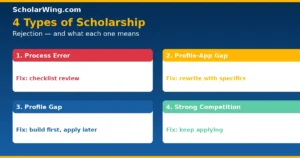
Category 1: Eligibility or Process Errors Application submitted with the wrong document format. Name spelling inconsistent across documents. Work experience hours short of the minimum. English test score just below the threshold. These rejections are not judgments about your potential, they’re administrative filters that occur before any academic or personal evaluation.
If you suspect this was the reason: review your next application’s eligibility checklist with someone else’s eyes, not just your own. See ScholarWing’s attestation and document guide: Document Attestation Apostille Guide Pakistan
Category 2: Strong Profile, Weak Application You have real leadership experience, relevant work history, and a genuine development contribution, but your application didn’t convey it compellingly. Vague return plans. Generic descriptions of leadership that could apply to anyone. An SOP that describes what you want to do rather than what you have already done.
This is the most common rejection category for qualified applicants and the most fixable. The profile exists; the application didn’t represent it accurately.
Category 3: Profile Gap The experience simply isn’t there yet. Not enough work experience for Chevening. No demonstrable leadership for Rhodes. No research track record for a DAAD PhD grant. And no amount of better writing will change this, the underlying profile needs to be built before the application will succeed.
If this is your situation, reapplying to the same program next cycle with the same experience will produce the same result. Something in the profile itself needs to change first. See: Build Competitive Scholarship Profile
Category 4: Strong Application, Strong Competition Sometimes you genuinely submitted a competitive application and didn’t succeed because country allocations are limited and this cycle had unusually strong competition in your specific pool. Chevening globally selects around 2-3% of applicants. In some countries and some years, qualified applicants are simply displaced by an unusually competitive cohort.
This is the rarest category and the least useful one to assume without evidence. Most applicants who didn’t succeed underestimate how fixable their application was.
How to Request Feedback After Rejection
Some scholarships offer feedback. Most don’t. Where it’s available, request it, it is the single most useful input you can have before reapplying.
Chevening: After the initial rejection (pre-interview stage), feedback is not provided. If you were shortlisted and interviewed but not selected, you can request interview feedback from your local British Embassy or High Commission. This is more useful than generic feedback because it tells you specifically which criterion the panel found weaker.
DAAD: Feedback varies by program. Contact the relevant DAAD regional office or the program coordinator directly. The DAAD office in your country (where one exists Accra, Nairobi, Addis Ababa, Islamabad) may be able to provide guidance.
Rhodes: The Rhodes Trust occasionally provides written feedback to unsuccessful applicants in some regions. Contact your regional Rhodes office directly after the decision.
Template for requesting feedback:
“Thank you for considering my application for the [Scholarship Name] [Year] cycle. While I understand that you receive far more qualified applications than available awards, I would greatly appreciate any feedback you are able to provide on my application — particularly regarding which criteria I could strengthen for a future application. Any guidance you can offer would be genuinely helpful.”
Keep it short, gracious, and specific. Long messages or expressions of frustration reduce the likelihood of a useful response.
Recognizing Scholarship Burnout
There is a difference between constructive persistence applying strategically across multiple cycles with evolving applications and burnout, which looks like persistence but produces nothing.
Signs you may be experiencing scholarship burnout rather than productive persistence:
- You are submitting applications with minimal changes from your previous rejected drafts because you don’t have the energy to rewrite them
- Scholarship application season fills you with dread rather than purposeful focus
- You are applying to more and more scholarships simultaneously but preparing each one less carefully
- Rejection letters produce a flat emotional response — not disappointment, just numbness
- You are applying to scholarships you are not genuinely eligible for or interested in, because it feels like doing something
- You have stopped updating your experiences because nothing significant has changed in your profile
Burnout produces applications that look complete but feel hollow to the applicant writing them, and often to the selection committee reading them. The solution is not to push through. The solution is to stop, recover, and then build something before reapplying.
What recovery looks like:
- A defined break from active applications — minimum 2-3 months
- A specific focus on building profile (leadership, community work, professional development) rather than writing applications
- Reconnecting with why you originally wanted this what specifically will this scholarship enable you to do that you genuinely want to do?
The Reapplication Decision: When to Try Again vs When to Change Strategy
Not every program is right to reapply to without change. Ask these questions honestly:
Question 1: Has something in my profile genuinely changed? If the answer is no, same work experience, same academic record, same community involvement, a reapplication to the same program will look like a rejection from the previous cycle, because nothing about your candidacy is different. The application may be slightly better-written, but the material hasn’t changed.
Question 2: Do I know specifically why I was rejected? If you have no feedback and no clear diagnosis, reapplying without change is a guess. At minimum, do an honest self-audit against the scholarship’s published selection criteria before submitting the same application again.
Question 3: Am I applying to this program because it genuinely fits me, or because I’ve been applying to it and it feels like giving up to stop? Persistence is a virtue. Sunk-cost persistence, continuing because you’ve already invested so much is not the same thing. If a different scholarship is actually a better fit for your profile and goals, applying there is not giving up. It is strategic adjustment.
Question 4: Is the problem the scholarship or the application? Try a different program in the same cycle. If you succeed elsewhere with a similar application, the previous rejection was program-specific. If you are rejected everywhere, the application or profile needs attention.
What Actually Changes Between Failed and Successful Cycles
Based on common patterns among applicants who succeed after earlier rejections, the most common differences are:
Return plan specificity. The most frequent improvement between a rejected and a successful application is a more specific, nameable return plan. “I will contribute to Pakistan’s education sector” becomes “I will return to Lahore within 12 months and join the Punjab Education Foundation as a curriculum specialist, applying my research to the Grade 1-3 literacy program currently serving 7,000 partner schools.” This is the same person, the same goal, made more credible by specificity.
Leadership evidence, not description. “I have strong leadership skills” becomes “In 2025, I identified a gap in our district health office’s data reporting and designed a new tracking system that reduced monthly reporting errors by 60%, adopted by 14 health facilities.” Same person, same experience, radically more compelling description.
Better program-scholarship fit. Some applicants were applying to Chevening when their profile, no strong work experience, primarily academic background was actually a better fit for Rhodes or an Erasmus Mundus consortium. Switching to the right program for your actual profile is often the most impactful change of all.
Applying to more programs simultaneously. First-time applicants often apply to one or two scholarships. Successful second-cycle applicants typically apply to four to six, with each application genuinely tailored. The odds aren’t great for any single program; they’re much better across a well-prepared portfolio. See: Scholarship Application Calendar 2026-2027
A Note on the Social Media Comparison Problem
Scholarship Facebook groups and WhatsApp channels are valuable for information. They are actively harmful for emotional wellbeing during rejection cycles.
When you are in the middle of a rejection, seeing others post their acceptance letters, their JW202 forms, their Chevening interview invitations, their DAAD offer emails, creates a comparison that isn’t useful information. It feels like evidence that you are failing when others are succeeding. But what you are actually seeing is a selected sample: people share acceptances far more than rejections, so the visible picture is systematically distorted toward success stories.
The same people posting acceptances have their own rejection cycles you’re not seeing. The scholarship journey for most successful scholars includes at least one year of rejection. Success in scholarships is not just about how good you are, but also about timing, fit, and persistence.
Mute the groups during your recovery period. Return when you are in active preparation mode and can engage with them as information sources rather than comparison points.
Practical Steps After a Rejection
- Take 5-7 days before analyzing — emotion distorts diagnosis
- Request feedback where available — use the template above
- Audit your application against selection criteria honestly — which of the 4 rejection categories applies?
- Identify one specific thing that will be genuinely different next cycle — not just better-written, but different
- Check whether a different scholarship is a better fit — see: How to Choose Between Multiple Scholarship Offers
- If you’re burned out, stop applying and start building — see: Build Competitive Scholarship Profile
- Use the calendar to identify your next realistic opportunity — see: Scholarship Application Calendar 2026-2027
- Rebuild your documents when you’re ready — free tools at: SOP Generator and Free CV Builder
FAQ
How many times can I apply to Chevening after rejection?
There is no stated limit on reapplication. You can apply to Chevening every cycle. However, applying with no meaningful change between cycles rarely produces a different result.
Does a previous rejection affect future applications to the same scholarship?
For most programs, no, each cycle is evaluated independently. However, for programs that require an interview (Chevening, Rhodes), selection committee members may occasionally recall a previous application if you are in the same regional pool. This is rarely a disadvantage if your application has genuinely strengthened.
How do I know if I’m burned out or just discouraged?
Discouragement is acute, it follows a specific rejection and fades with time. Burnout is chronic, it involves dreading the whole process, submitting increasingly hollow applications, and losing connection with why you wanted this. If the application process feels like an obligation without purpose, that’s burnout, not discouragement.
Should I apply to the same scholarship I was rejected from, or try a different one?
Try a different one if your profile fits it better. Try the same one if something specific and meaningful has changed in your candidacy. Apply to both if you can prepare genuinely tailored applications for each.
My friend with lower grades got a scholarship I was rejected from. Why?
Scholarship selection is multi-dimensional. A lower GPA paired with exceptional leadership evidence, a more specific return plan, and a more compelling personal narrative regularly outperforms a higher GPA paired with a generic, vague application. Grades are one input, not the deciding one.
When should I seek external support?
If scholarship rejection is consistently affecting your sense of self-worth, your ability to function day-to-day, or your relationships, rather than being an acute disappointment that passes, speaking with a counselor, mental health professional, or trusted mentor is worthwhile. A scholarship outcome is not a measure of your worth or capability. If it’s starting to feel like one, that’s a signal worth taking seriously.