
Most Students Who Don’t Apply Have Already Ruled Themselves Out Based on Something That Isn’t True
Every year, thousands of eligible students never submit a single scholarship application. Not because they lack qualifications because they have accepted as fact something they heard in a Facebook group, from a friend, or from an agent with a financial interest in their confusion.
This guide exists to remove those barriers. Each myth below is followed by what is actually true, with specific evidence from real scholarship programs. Some of these will surprise you. Most will make you realize you should have applied last cycle.
Scholarship Myths Debunked:
Myth 1: “You Need IELTS 7.0 or Higher to Get a Scholarship”
The truth: Multiple major fully funded scholarships require no IELTS at all and many others accept a free alternative that most students don’t know about.
Programs that explicitly accept a free Medium of Instruction (MOI) Certificate instead of IELTS:
- DAAD Germany — MOI Certificate accepted for English-medium programs
- CSC China — MOI Certificate accepted for English-taught programs
- GKS Korea — no English test required at all
- Stipendium Hungaricum — varies by program, but MOI often accepted
Programs requiring no English test whatsoever:
- Turkiye Burslari — no IELTS, no TOEFL, no MOI
- GKS Korea Embassy Track — no English test requirement
And These Programs where IELTS is required but at a realistic threshold:
- Chevening UK — 6.5 overall (not 7.0)
- Commonwealth — English proficiency demonstrated, no specific score published
A free MOI Certificate is a letter from your university registrar confirming your degree was taught in English. It costs nothing and takes one visit to your university. Generate the correct format at: Free MOI Generator
Myth 2: “You Need a 3.8+ GPA — My Grades Are Too Low”
The truth: The lowest GPA minimum of any major government scholarship is 2.64/4.0 and several major programs publish no minimum GPA at all.
Confirmed minimums for 2026:
- GKS Korea — minimum 2.64/4.0 — the lowest of any major government scholarship
- CSC China — no published universal GPA minimum
- Turkiye Burslari — 75% equivalent (approximately 2.5/4.0)
- Stipendium Hungaricum — varies by program, generally no strict universal minimum
Programs like Chevening, Rhodes, and DAAD Leadership for Africa weight leadership experience and development impact heavily alongside academic records, a student with a 2.8 GPA and five years of relevant professional experience is a genuine Chevening candidate. A student with 3.9 and no demonstrable leadership history is not.
GPA is one input. It is not the gate it is believed to be.
If your GPA is genuinely low and you want to understand your realistic options, see: Low GPA Scholarships
Myth 3: “Fully Funded Means I Won’t Pay Anything”
The truth: “Fully funded” describes what the scholarship covers after you arrive. Before you get there, you pay for a series of pre-departure costs entirely out of your own pocket.
What you typically pay before your scholarship stipend starts:
- IELTS or TOEFL test fee (USD 200-250 per attempt) — unless you use a free MOI Certificate
- Document attestation fees (HEC, IBCC, MOFA, apostille)
- Medical examination (mandatory for China X1 visa)
- Visa application fee
- UK Immigration Health Surcharge (for Chevening/Commonwealth)
- Passport renewal if needed
- Courier, printing, and notary costs
None of these are paid by your scholarship. They come before your stipend begins, and they add up to a real number you need to budget for in advance.
Full breakdown of every pre-departure cost: Hidden Costs Fully Funded Scholarship
Myth 4: “Scholarship Agents Get You Better Chances”
The truth: No scholarship agent has any influence over selection outcomes. None. Zero.
Every major international scholarship DAAD, Chevening, Fulbright, CSC China, GKS Korea, Rhodes, Commonwealth, Turkiye Burslari is selected by independent academic committees whose members are not connected to, and actively protected from, any form of external influence or intermediary.
DAAD explicitly states on their website: “DAAD staff are not entitled to vote in the scholarship selection procedure. In order to maintain the independence of our volunteer selection committee members, we ensure that they can make their assessments without any influence or bias.”
What agents actually do, when legitimate, is help you organize documents and check your application for completeness. This is useful, but it is also work that a well-organized applicant can do themselves using free resources.
What agents cannot do: contact selection committees, influence outcomes, guarantee results, or fast-track your application in any way.
Paying USD 300-500 to an agent for document preparation is paying for a service but ScholarWing provides free: Sop Generator · Free CV Builder · Motivation Letter Generator
Myth 5: “Only Students From Top Universities Get Scholarships”
The truth: Most major international scholarships do not filter applicants by the ranking or prestige of their undergraduate institution.
DAAD’s selection criteria: academic record, project quality, motivation, and applicant potential. No shortlist of approved universities.
Chevening’s selection criteria: leadership potential, UK connection, and clarity of study plan. Explicitly evaluates what you have done and will do, not where you studied.
Mastercard Foundation explicitly targets students from disadvantaged backgrounds, including those who studied at under-resourced institutions because they had no other option.
Rhodes scholarship applications are evaluated across intellectual curiosity, character, commitment to service, and leadership. A graduate of a less-known institution who demonstrates these qualities genuinely is evaluated on those qualities.
The student from a prestigious institution with a generic, vague application loses to the student from a less-known institution with a specific, compelling, honest one. This happens. It is not rare.
Myth 6: “I Missed This Year’s Deadline — I Have to Wait a Full Year”
The truth: Because scholarship deadlines are spread across all 12 months of the year, there is almost never a point where no major scholarship is open or approaching.
Missing Chevening’s November deadline does not mean waiting until August 2027. CSC China opens in December. GKS Korea closes in February. MEXT Japan remains open until May. Erasmus Mundus has programs closing January through March. Turkiye Burslari typically opens January-February.
The scholarship year is a continuous cycle, not a single annual window.
The full month-by-month breakdown: Scholarship Application Calendar 2026-2027
Myth 7: “You Can Only Apply to One Scholarship at a Time”
The truth: Applying to multiple scholarships simultaneously is not only allowed, it is the correct strategy.
Most successful scholarship winners apply to between five and eight programs per cycle. Your core documents, CV, base motivation letter, academic transcripts, recommendation letters — are built once and customized per program. The marginal effort per additional application, once your core materials are prepared, is 3-5 hours of customization, not weeks of work.
The one practical constraint: once you accept an offer, most scholarships require you to notify them if you receive another award from a government source. Some permit holding both; some require you to choose. Read the terms of each accepted offer carefully.
Applying to one scholarship at a time and waiting for each result before applying to the next is how students spend three or four years not studying abroad. Apply to multiple. See: Scholarship Application Tips
Myth 8: “If You Got Rejected Once, You’re Permanently Disqualified”
The truth: Most scholarships allow, and many explicitly encourage reapplication. Rejection is information, not a permanent disqualification.
- Chevening — you can reapply the following cycle. No limit stated on number of attempts.
- DAAD — you can reapply. Programs where you have been previously funded have specific rules about re-application for additional funding, but initial rejections do not bar future attempts.
- CSC China — explicitly states “You can reapply in the next cycle. There is no limit on the number of times you can apply.”
- Rhodes — previous unsuccessful applicants may reapply. Many Rhodes Scholars were unsuccessful in a prior cycle.
What changes between a rejection and a successful second application is almost always one of three things: a more specific return plan, a stronger leadership record built in the intervening year, or a better-fit program selection. Rejection without change produces the same result. Rejection with identified and addressed weaknesses produces a different one.
Myth 9: “I Need to Be Under 25 to Apply”
The truth: Age limits vary enormously by program, and many major scholarships have no age limit at all or limits well above 25.
- DAAD — no general age limit. The binding constraint is the 6-year window since your most recent degree.
- Chevening — no age limit. Requires 2+ years of work experience, which structurally means most applicants are 25+.
- Fulbright — no age limit.
- Commonwealth — no age limit.
- Mastercard Foundation — specifically targets young Africans, with most programs for applicants in their mid-to-late 20s.
- Turkiye Burslari — under 30 for Master’s, under 35 for PhD. Still accessible to late-20s applicants.
- CSC China — under 35 for Master’s, under 40 for PhD.
- GKS Korea — under 40 for the general track.
DAAD’s most competitive programs — the EPOS development-related courses and the Leadership for Africa program, explicitly require at least two years of post-graduation work experience, meaning they structurally favor applicants in their late 20s and 30s.
Myth 10: “Fully Funded Scholarships Don’t Allow You to Bring Your Family”
The truth: Most scholarships allow family members to join you, though the financial support and conditions vary significantly.
- DAAD — pays a partner allowance of EUR 276/month and a child allowance of EUR 259/month per child, for programs over 6 months
- Commonwealth — family allowances available conditionally for programs over 18 months
- CSC China — family can join on S1/S2 dependant visas at your own expense; scholarship does not fund dependants
- Chevening — technically permitted under current UK rules for government-sponsored scholars on 6+ month courses, but Chevening provides no financial or immigration support and strongly advises against it
The full detailed guide: Bringing Spouse Children on Scholarship
Myth 11: “You Need to Choose One Destination Country and Specialize”
The truth: Many of the world’s most competitive applicants apply to Germany AND China AND Korea AND the UK in the same cycle. These aren’t competing applications, they’re parallel strategies.
DAAD, CSC China, GKS Korea, and Erasmus Mundus all have overlapping preparation windows and compatible document requirements. A core CV, base SOP/motivation letter, and confirmed recommenders built once for DAAD can be customized for CSC in a few hours. Customized again for GKS in a few more.
Spreading across multiple destinations reduces your exposure to any single selection committee’s subjective judgment, and increases the probability that at least one of your well-prepared applications succeeds.
The only constraint: once you accept an offer, honor it. Apply broadly, then choose deliberately from what you win.
For help choosing: How to Choose Between Multiple Scholarship Offers
Myth 12: “Scholarship Applications Are So Competitive That Applying Is Pointless”
The truth: Acceptance rates vary enormously by program, and the effective competition pool for most applicants is smaller than the headline numbers suggest.
Chevening receives ~65,000 applications annually for approximately 1,500 awards, roughly 2.3% acceptance rate globally. But: most scholarship bodies select from country-specific pools, not a single global competition. A Pakistani applicant competes against other Pakistani applicants for Pakistan’s country allocation, not against 65,000 people from 160 countries simultaneously.
CSC China has no published acceptance rate and processes hundreds of thousands of applications, but Silk Road scholarship quotas are country-specific, meaning Angolan applicants compete against a much smaller pool of Angolan applicants for Angola’s allocation.
GKS Korea has a minimum GPA of 2.64/4.0 and no English test requirement, its effective competition pool is every reasonably qualified student from an eligible country who prepares a competent application. This is a genuinely accessible scholarship.
The practical reality: a well-prepared, specific, honest application in the correct program for your profile succeeds at rates the headline numbers don’t reflect. The students who don’t apply because they think it’s pointless are, statistically, reducing your competition.
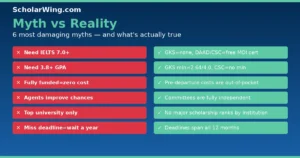
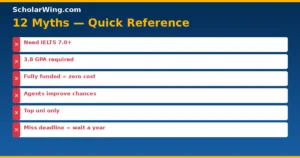
Quick Reference: Myths vs Facts
| Myth | Fact |
|---|---|
| Need IELTS 7.0+ | GKS Korea needs no test; DAAD/CSC accept free MOI Certificate |
| Need 3.8+ GPA | GKS minimum is 2.64/4.0; CSC China has no published minimum |
| Fully funded = zero cost | Pre-departure costs (visa, attestation, medical) are out-of-pocket |
| Agents improve your chances | Selection committees are completely independent — agents have zero influence |
| Only top-university graduates qualify | No major scholarship filters by institution ranking |
| Missed deadline = wait a year | Deadlines span all 12 months; CSC/GKS/MEXT open through May |
| Apply to one at a time | Apply to 5-8 simultaneously — this is the correct strategy |
| Rejection = permanent disqualification | Most scholarships allow unlimited reapplication |
| Must be under 25 | DAAD/Fulbright/Chevening have no age limits; EPOS favors experienced applicants |
| Family not allowed | Most scholarships allow family; DAAD pays allowances for 6+ month programs |
| Must specialize in one country | Apply broadly across DAAD, CSC, GKS, Erasmus simultaneously |
| Too competitive to bother | Country-specific pools are smaller; specific applications succeed |
FAQ
Is IELTS required for all international scholarships?
No, DAAD, CSC China, and GKS Korea accept a free MOI Certificate. Turkiye Burslari requires no English test at all. Chevening requires IELTS 6.5, not 7.0.
What is the lowest GPA accepted by a major scholarship?
GKS Korea has the lowest published minimum, 2.64/4.0. CSC China has no published universal minimum.
Can scholarship agents guarantee results?
No, selection committees are fully independent of any external influence. No agent has any connection to or influence over selection outcomes.
Is it too competitive to apply?
Most scholarship selection happens within country-specific pools, not a single global competition. A well-prepared application in the right program for your profile succeeds at better rates than headline acceptance statistics suggest.
Can I apply to multiple scholarships in the same year?
Yes, applying to 5-8 programs per cycle is standard practice among successful applicants.