
Winning Multiple Scholarships Is a Good Problem — But Still a Real Decision
Most scholarship guides talk about how to win. Almost none talk about what to do when you win more than one.
It happens more often than people expect. Students who apply strategically to 4-5 programs simultaneously, which is the correct approach — sometimes receive multiple offers in the same cycle. GKS and CSC in the same year. DAAD and Erasmus Mundus. Chevening and Commonwealth. Even Chevening and Fulbright in the same cycle, though these have conflicting residency requirements if both are accepted.
Choosing between offers is not obvious. The scholarship with the higher stipend may have a longer return obligation. The more prestigious one may be in a country where your career won’t benefit as much. The “lesser” program may be at a university whose research group is a far better fit for your actual goals.
This guide gives you a structured framework for making this decision, seven factors, real 2026 stipend figures, and head-to-head comparisons of the most common offer combinations.
The 7-Factor Decision Framework
When comparing two or more scholarship offers, evaluate each one across these seven dimensions. Not all carry equal weight, rank them based on your personal priorities before applying the framework.
Factor 1: Stipend and Real Purchasing Power
The headline stipend figure is rarely the most important financial metric. What matters is purchasing power in the destination city, how far does that money actually go?
Confirmed 2026 stipend figures:
| Scholarship | Monthly Stipend | City Context |
|---|---|---|
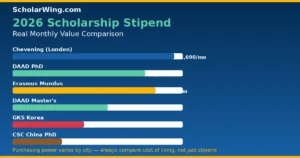
| Chevening UK | £1,690 (London) / £1,378 (outside London) | High cost of living |
| DAAD Master’s | €934/month | Moderate — varies by German city |
| DAAD PhD | €1,300/month | Moderate |
| Erasmus Mundus | €1,100–€1,400/month | Varies by EU country rotation |
| CSC China Master’s | CNY 2,500/month (~USD 340) | Low cost of living |
| CSC China PhD | CNY 3,500/month (~USD 480) | Low cost of living |
| GKS Korea | KRW 1,000,000/month (~USD 700) | Moderate |
| Turkiye Burslari | TRY stipend (~USD 300-350) | Low-moderate |
| Stipendium Hungaricum | ~EUR 115/month | Low — Budapest affordable |
The key insight: A CSC China stipend of CNY 2,500 in a Chinese university city where campus housing is free and food costs are low may provide a more comfortable lifestyle than £1,378 in a UK city with £900+ monthly rent. Run a cost-of-living comparison for your specific program city, not just the headline stipend figure.
Tools to compare: numbeo.com/cost-of-living/enter both cities and compare.
Factor 2: Return Obligation — How Long Are You Committed?
Many fully funded scholarships require you to return to your home country for a defined period after graduation. This obligation affects your career flexibility immediately after your degree and must be factored into your decision.
| Scholarship | Return Obligation |
|---|---|
| Chevening | 2 years return to home country — formally required |
| Fulbright | 2 years home residency — legally binding for J-1 visa holders |
| Australian Awards | 2 years return to home country |
| DAAD | No formal return obligation — moral expectation of development contribution |
| CSC China | No formal return obligation |
| GKS Korea | No formal return obligation |
| Erasmus Mundus | No formal return obligation |
| Commonwealth | Strong expectation to return — not always legally binding |
If your career plan involves staying abroad after graduation — working in Germany after a DAAD degree, for example, a Chevening or Fulbright offer creates a legal barrier that DAAD or Erasmus Mundus does not. This factor alone can be decisive for students with specific post-graduation work plans.
Conversely, if you plan to return anyway, the return obligation is irrelevant to your decision, in which case stipend and program quality take precedence.
Factor 3: Degree Recognition and Career Portability
Where will you use this degree, and will it be recognized there?
UK, US, Australian, and German degrees are recognized virtually everywhere in the world, professional licensing bodies, graduate admissions committees, and employers globally recognize these credentials.
Chinese and Korean degrees are increasingly recognized, particularly in Asia, Africa, and the developing world and for technical fields like engineering and computer science, they are strong credentials globally. However, in some countries and professions, a CSC China degree may face more scrutiny than a European or North American equivalent.
Erasmus Mundus degrees are issued jointly by 2-3 European universities and are increasingly recognized globally, but the dual/triple degree format can occasionally cause confusion with professional licensing bodies in some countries.
Practical question: Where will you work after graduation? If the answer is your home country or a developing country, the prestige difference between a German, Chinese, or Korean degree may be less significant than in a developed-world job market. If the answer is North America or Northern Europe, degree origin matters more.
Factor 4: Program and University Fit
This is the factor most students underweight, because they are focused on the scholarship brand rather than what they will actually study.
Ask these questions for each offer:
- Is the specific university in the top tier for my field, or just top-ranked overall?
- Does the research group or faculty I’ll work with match my actual research interests?
- Is the program curriculum at the right depth and level for where I am now?
- Is the degree in my primary language of instruction, or will I spend the first year catching up linguistically?
A DAAD scholarship at a German university with a world-leading research group in your specific field is a better academic outcome than a Chevening scholarship at a UK university where your program is average. Program fit outlasts scholarship prestige in almost every career outcome.
Factor 5: Language of Study and Integration
If you are choosing between scholarships where one requires a new language and one doesn’t, weight this carefully.
English-medium offers: Chevening, Fulbright, Commonwealth, GKS Korea, CSC China (for English-track programs), Australian Awards, all primarily English-medium with no new language required.
German-medium DAAD programs: Some DAAD tracks require German, typically B2 level minimum. If you don’t speak German, this means a language preparation course (DAAD often funds this, 3-6 months) before your degree starts, adding time but also a language skill.
Turkish programs (Turkiye Burslari): Includes a paid one-year Turkish language course before studies. If your program is Turkish-medium, that first year is language-focused.
Practical rule: Don’t be deterred by a language requirement if the program and career upside justify it, a funded German language course plus a German Master’s degree is a career asset. But be honest with yourself about whether you will thrive in a linguistically demanding environment.
Factor 6: Alumni Network and Career Ecosystem
Each major scholarship has a global alumni network and these networks vary enormously in their practical value for your specific career goals.
Chevening: 50,000+ alumni in 160 countries. Explicitly positioned as a network of “future global leaders.” Strongest for public policy, diplomacy, international development, journalism, finance, and law. The Chevening Alumni Association in many countries is genuinely active and provides real career connections.
Fulbright: One of the world’s most recognized alumni networks. Strongest for academia, research, public policy, and US-linked careers. Notable alumni include heads of state, Nobel laureates, and senior academics globally.
DAAD: 100,000+ alumni. Strongest for engineering, sciences, academia, and Germany-linked careers. DAAD alumni chapters in many developing countries are active.
Erasmus Mundus: Growing alumni network, strongest in Europe. The multi-country nature of the degree means you build networks in 2-3 European countries simultaneously, an advantage for European career ambitions.
CSC China: Large and growing alumni network, strongest for Asia-Africa South-South cooperation, Chinese-linked business, and technical fields. Less useful for North American or European career paths.
Practical question: Where do you want to be in 10 years, and which alumni network is most present in that world?
Factor 7: Can You Actually Hold Both?
Before you spend time deciding between offers, confirm whether you can even hold both scholarships simultaneously or whether one must be declined.
Known conflicts:
- Chevening and Fulbright both carry residency requirements (2-year home return) — you cannot fulfill both simultaneously if you win both in the same cycle. One must be deferred or declined.
- Most government scholarships (DAAD, GKS, CSC, Turkiye Burslari) prohibit holding another government scholarship simultaneously — check each scholarship’s terms.
- Erasmus Mundus and most EU scholarships prohibit simultaneous EU funding from other sources.
What’s generally permitted:
- Applying to multiple scholarships simultaneously is allowed and encouraged everywhere
- Restrictions typically only activate at the point of acceptance, not application
- Some scholarships explicitly permit co-holding with certain others — check your offer letter terms
Head-to-Head: Most Common Offer Combinations
CSC China vs GKS Korea
Both are no-IELTS, no-minimum-GPA programs with similar accessibility. Key differences:
- Stipend: GKS (~USD 700) outpaces CSC Master’s (~USD 340) in absolute terms, though China’s lower cost of living partially offsets this
- Language: CSC often requires Chinese language study; GKS includes a funded Korean language year
- Career: CSC stronger for Africa-Asia development and technical fields; GKS stronger for Korean industry connections and East Asian careers
- Degree recognition: Both growing globally; GKS slightly stronger in Southeast Asia, CSC stronger in Africa
Choose CSC if: Your field is engineering, agriculture, or development-oriented and your career is Africa or South-South cooperation focused. Choose GKS if: You want a higher stipend in real terms, Korean tech industry exposure, or Southeast Asia career paths.
DAAD vs Erasmus Mundus
- Stipend: DAAD (€934/month Masters, €1,300 PhD) vs Erasmus Mundus (€1,100-1,400/month)
- Location: DAAD = Germany only; Erasmus Mundus = 2-3 European countries (multi-campus)
- Network: DAAD stronger for Germany specifically; Erasmus stronger for pan-European career
- Return obligation: Neither has formal return requirement
- Language: DAAD may require German for some programs; Erasmus Mundus often English-medium
Choose DAAD if: Germany is your target career location, or your research group there is world-class for your field. Choose Erasmus Mundus if: You want European breadth, multi-country experience, and a stronger pan-European professional network.
Chevening vs Commonwealth
Both are UK-based, one-year Master’s scholarships with similar funding levels and a 2-year return obligation.
- Stipend: Chevening £1,690 (London) / £1,378 (outside); Commonwealth £1,347 — Chevening slightly higher
- Selection focus: Chevening = leadership + UK engagement; Commonwealth = academic excellence + development impact
- University choice: Chevening = any eligible UK university; Commonwealth = specific universities per your field
- Alumni network: Chevening alumni are more globally connected and actively networked; Commonwealth more academically oriented
Choose Chevening if: Your goals are in public policy, leadership, media, or international relations, and you have strong UK-specific reasons. Choose Commonwealth if: Academic research depth and development impact are your primary goals, and you’re not a strong “leadership narrative” fit for Chevening.
Read This Also: How to Choose the Right Scholarship for You 2026 — Complete Guide
When You Still Can’t Decide
If you’ve applied the framework and remain genuinely undecided, two practical approaches:
1. Ask the alumni Find scholarship alumni from your country on LinkedIn. Send a short, specific message, “I’m deciding between X and Y. What was your experience?” Alumni responses are more valuable than any comparison article, including this one, because they reflect the lived reality of your specific program in your specific context.
2. Default to program fit over scholarship brand If every other factor is genuinely equal, choose the program where the specific university, faculty, and curriculum are the strongest fit for what you want to research or learn. You live with the program for 1-3 years. You benefit from the scholarship brand for the rest of your career, but the difference in career benefit between most major scholarships is smaller than the difference between a perfectly fitting program and an average one.
Quick Decision Checklist
Before making your final decision, confirm:
- ☐ Can I hold both offers simultaneously, or must I decline one?
- ☐ What are the exact return obligations of each?
- ☐ Which city/country has better real purchasing power for my stipend?
- ☐ Which degree is better recognized in the country where I want to work?
- ☐ Which alumni network is more useful for my specific career?
- ☐ Which program/faculty/university is the stronger academic fit?
- ☐ Do I need to learn a new language for either program?
- ☐ Have I contacted an alumnus of each program for first-hand input?
FAQ
Can I apply to Chevening and Fulbright in the same year?
Yes, applying simultaneously is allowed and common. However, both carry a 2-year home residency requirement, and if you win both, you can only fulfill one return obligation at a time. You would need to defer or decline one offer.
Can I hold DAAD and Erasmus Mundus simultaneously?
Generally no, most EU scholarship programs and government scholarships prohibit concurrent receipt of other government funding. Check both offer letters for their specific terms.
Which scholarship has the highest stipend in 2026?
In absolute monthly figures, Chevening (£1,690 in London) leads among the most accessible government scholarships. However, in terms of real purchasing power, DAAD (€934-€1,300) and GKS (~USD 700) often provide a more comfortable lifestyle given lower costs of living in Germany and Korea compared to London.
Does the scholarship brand matter more than the university?
For most career paths, the university and program matter more in the long run. Scholarship brand is important, but a Chevening scholarship at an average UK university for an average-fit program will produce weaker career outcomes than a DAAD scholarship at a world-leading German research group in your exact specialty.
What happens if I accept one offer and then decline it after finding out about another?
Declining after acceptance is possible but has consequences, some programs record your name and it may affect future applications. Try to make your decision before accepting any offer, or as soon as possible after receiving all decisions. Contact the scholarship programs honestly and promptly if you need to decline.
Is it better to take the higher-stipend or higher-prestige scholarship?
Neither category wins universally. Map the decision against your specific career destination, goals, and program fit using the framework above. A higher stipend in a lower-cost country often provides better quality of life than a prestigious scholarship in an expensive city.