

The Student Who Lost a Chevening Scholarship He Already Won
His Chevening application was strong. He got the conditional offer. Then he discovered that Oxford — his only real choice had rejected him. His two backup courses? One had already closed applications. The other didn’t align with his stated career goals at all.
He lost his Chevening scholarship. Not because his application was weak. Because he misunderstood how university selection works.
This guide exists so you don’t make the same mistake.

The Official Rule — 3 Courses, One Unconditional Offer Required
Chevening requires you to submit three different UK Master’s courses in order of preference. You need to apply directly to each university through their own website. You must secure an unconditional offer from at least one of your three course choices by the offer deadline stated in the application timeline.
Choosing three courses gives you backup options if your first choice doesn’t work out and helps application assessors better understand your career goals.
Critical consequence: If none of your three course choices results in an unconditional offer, your Chevening scholarship evaporates, even if your personal application was excellent. If all three reject you, Chevening may consider a request to apply to alternative courses, but this is granted case-by-case and far from guaranteed.
You only get one chance to get this right.
The Dream-Target-Safety Framework
Course 1: Your Dream Choice Apply to a prestigious institution, Oxford, Cambridge, LSE, or Imperial. These are competitive, but Chevening scholars have been accepted to every top-tier UK institution. If your academic and professional profile is genuinely strong in your field, apply.
However: don’t build your entire application around one dream institution. Your essays, career plan, and interview preparation should not be so tightly tied to Oxford that the rest of your application collapses if Oxford rejects you.
Course 2: Your Strong Match (Target) Choose universities consistently in the UK top 10-15 in your field: UCL, King’s College London, Warwick, Manchester, Edinburgh, Durham. These are excellent institutions with good acceptance rates for competitive applicants.
This is typically your most important choice strategically. It should be a genuinely strong program that serves your career goals, at a university where your academic profile puts you in a competitive position for an offer.
Course 3: Your Safety Net A quality program at a welcoming institution with higher acceptance rates — Bath, Glasgow, Sheffield, Southampton. Still a credible, quality program that serves your stated goals. Not a throwaway choice — your essays and career narrative must still be coherent if you end up studying here.
The key rule: All three university choices should be coherent and aligned with the stated career plan. Inconsistency in course selection raises doubts during interviews.
The Most Dangerous Mistake: Applying to Only Elite Universities
Most applicants make the mistake of only targeting Oxford and Cambridge while prestigious, these are extremely competitive and acceptance rates for Chevening scholars are low. Targeting only elite universities is risky. Even with Chevening funding, acceptance rates are 15-25%. A balanced portfolio including strong target and safety universities significantly increases acceptance likelihood.
The logic is simple: you could win Chevening and still lose it if all three of your universities reject you. Oxford, Cambridge, and LSE all have independent admissions processes and international students compete with the full global applicant pool for limited places, regardless of Chevening status. Having a Chevening conditional offer does not guarantee university admission.
How to Research Programs — Go Deeper Than Rankings
Most applicants open Times Higher Education, pick the top three universities, and call it done. This produces poor course selection. Do this instead:
Look at actual modules, not program overviews Two universities might both offer “International Development” degrees, but one focuses on quantitative economics while the other covers governance and human rights. If your career goals require governance expertise, the quantitative program at the higher-ranked university is the wrong choice.
Look at faculty research, not just names Which professors are actively publishing in your area? Can you name specific researchers at each institution whose work connects to your goals? This level of specificity strengthens your essays and your interview answers.
Consider location and cost Consider location — London vs other cities affects costs. Chevening’s living allowance in London is higher than outside London, but London’s cost of living means the effective purchasing power may be similar or lower. For some fields, London is essential (finance, international policy). For others, Manchester or Edinburgh offer equivalent academic quality at lower personal cost.
Use the official Chevening course finder Use the Chevening course finder to ensure your choices qualify for a Chevening Scholarship. Not every UK Master’s program is Chevening-eligible. Check this before investing application effort.
Coherence — What Assessors Look For
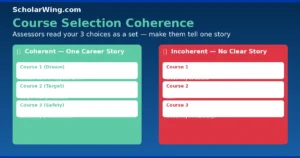
Your three course choices are evaluated not just individually but as a set. They should tell a coherent story about your goals.
Coherent example:
- MSc Public Health Policy — London School of Hygiene & Tropical Medicine (dream)
- MSc Global Health — King’s College London (target)
- MSc International Health Management — University of Manchester (safety)
All three lead to the same type of role. All three connect to the same stated career goals. An assessor reading these three choices understands immediately what you want to do with your career.
Incoherent example:
- MSc International Relations — Oxford
- MSc Computer Science — UCL
- MBA — University of Edinburgh
These tell no single career story. Even if each choice is individually strong, the combination signals either confusion about career goals or random prestige-chasing both of which weaken a Chevening application.
Pre-Sessional Courses — An Important Warning
Pre-sessional courses to meet your university’s English language requirement or other conditions are not permitted and will result in losing your Chevening Scholarship for that course. Some courses may have required introductory elements called ‘pre-sessional’ courses. If this applies, inform your Chevening Program Officer.
Check this carefully. If a course listing mentions “pre-sessional English” or “foundation modules” as entry requirements for international students, that course may not be eligible or may be conditional in ways that affect your Chevening award.
Read This: Chevening Scholarship 2026-27 – Complete Guide
Frequently Asked Questions
Can I change my course choices after submitting my Chevening application?
Generally, you cannot change your course choices after submitting your application. In exceptional circumstances, changes may be allowed at the interview stage.
Does applying for a Chevening Partner university give me an advantage?
Choosing a course at a Chevening Partner university does not affect the amount of funding you receive. You can select any eligible course at any UK university.
What if I only get an offer from my third-choice university?
You study at your third choice. Chevening funds your scholarship at whichever institution gives you an unconditional offer first. Choose your third option carefully, it might be where you actually end up.
Do I need to apply to universities before submitting my Chevening application?
It is up to you whether you apply for your courses before or after submitting your Chevening application. What’s important is that you don’t miss any UK university deadlines and that you secure an unconditional offer from at least one of your course choices by the offer deadline.