
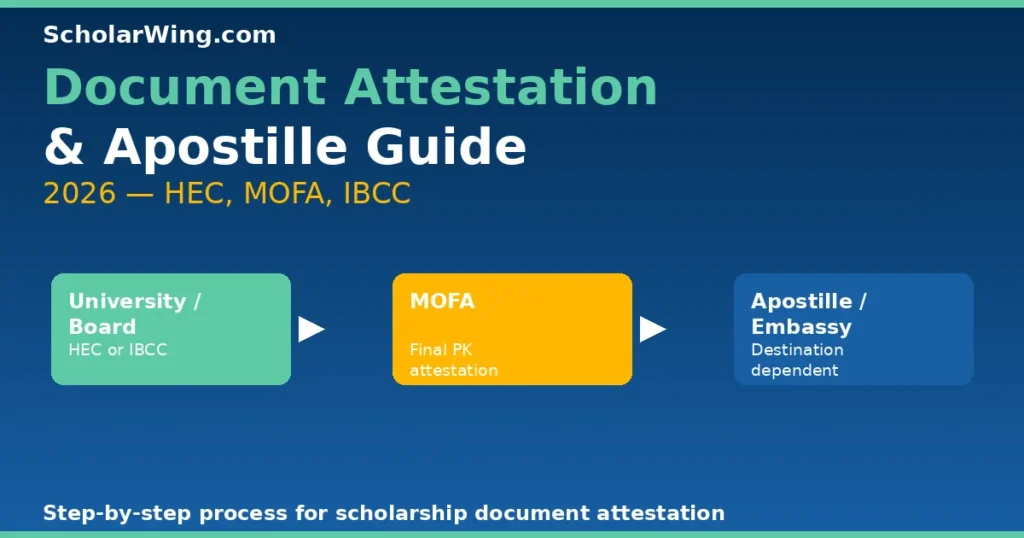
Most Scholarship Applicants Don’t Understand Attestation Until It’s Too Late
Every scholarship cycle, students who have already won admission and funding lose weeks waiting for document attestation they didn’t realize they needed, or worse, submit documents attested through the wrong chain entirely, forcing them to start over.
Attestation is not optional paperwork. It is the legal process that makes your Pakistani degree, transcript, or certificate recognized and trustworthy outside Pakistan. Universities, scholarship bodies, and immigration authorities in almost every destination country require it in some form. This guide explains exactly which authority verifies what, how the chain works, which countries need apostille versus full embassy attestation, and the mistakes that cause the most delays.
The Three-Step Attestation Chain, Explained
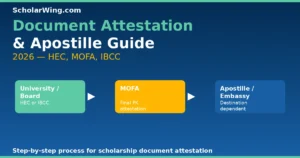
Every document attestation in Pakistan follows the same basic structure, verification happens in layers, and each layer must be completed before moving to the next.
Step 1: Pre-verification by the issuing authority Before any document goes to MOFA, it must first be verified by the body that actually issued or oversees it:
- University degrees and transcripts → Higher Education Commission (HEC)
- Matric and Intermediate certificates → Inter Board Committee of Chairmen (IBCC)
- Birth certificates, family registration, marriage certificates → NADRA or Union Council
MOFA will not accept any document for attestation without this pre-verification completed first. This is the step most applicants skip or get wrong.
Step 2: MOFA attestation Once pre-verified, your document is submitted to the Ministry of Foreign Affairs (MOFA) for the final Pakistan-side attestation. This step confirms, at the government level, that your document and its pre-verification are authentic.
Step 3: Apostille or embassy attestation (destination-dependent) After MOFA, your document needs one of two final steps depending on where you’re sending it:
- Apostille — for countries that are members of the 1961 Hague Apostille Convention
- Embassy/consulate attestation — for countries that are NOT Hague members
This final step is where most confusion happens, because it depends entirely on your destination country, not on the type of document.
HEC Degree Attestation — Now Fully Online (2026 Update)
This is the most important update for scholarship applicants in 2026: HEC no longer requires in-person visits or physical document submission for most degree attestation.
In May 2026, HEC launched a fully online, paperless Degree Attestation System (DAS) built on blockchain technology. You no longer need to visit HEC regional offices or hand over physical original documents to HEC for verification.
How to use the new system:
- Register at eservices.hec.gov.pk — existing account holders simply log in
- Upload documents — clear scans of your degree, transcripts, and CNIC. The portal accepts applications 24/7
- University verification — HEC electronically forwards your credentials to your degree-issuing university for verification
- Receive your attested certificate — once verified, your HEC attestation is issued digitally and linked via blockchain for authenticity
This eliminates what used to be one of the most time-consuming parts of the entire process, physically traveling to an HEC regional office and waiting in line.
Who can apply: Anyone who completed a degree from an HEC-recognized Pakistani institution.
IBCC Attestation for Matric and Intermediate Certificates
If your scholarship application requires attestation of secondary school documents (common for Bachelor’s-level scholarship applicants), Matric and Intermediate certificates must go through the Inter Board Committee of Chairmen (IBCC) first — not HEC.
IBCC verifies that your school-level academic history is correctly documented before MOFA will accept these certificates for further attestation.
Important: If you’re applying with a foreign qualification equivalence (for example, O-Levels or A-Levels), the equivalence certificate issued by IBCC must itself be attested before moving to MOFA.
Apostille — Which Scholarship Destination Countries Accept It
The apostille is a single-stamp certification under the Hague Convention of 1961 that makes your Pakistani documents legally recognized in any other member country, without needing separate embassy attestation for each one.
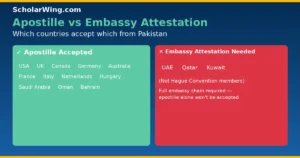
Countries that accept apostille from Pakistan (relevant to ScholarWing’s most common scholarship destinations):
United States, United Kingdom, Canada, Australia, Germany, France, Italy, Netherlands, Spain, Switzerland, Belgium, Austria, Sweden, Norway, Denmark, Finland, Ireland, Portugal, Greece, Poland, Czech Republic, Hungary, Romania, New Zealand, Saudi Arabia, Oman, and Bahrain.
This means if you’re applying to DAAD (Germany), Chevening (UK), Erasmus Mundus (any EU member), Fulbright (USA), Stipendium Hungaricum (Hungary), or most European and Commonwealth scholarship programs, apostille is the correct and simpler final step, not full embassy attestation.
Countries NOT covered by apostille (as of mid-2026): UAE, Qatar, and Kuwait are not parties to the Hague Apostille Convention. If you need documents recognized in these countries, you must complete the full embassy/consulate attestation chain instead of apostille.
A Note on China and CSC Scholarship Documents
China’s situation deserves a separate explanation because it differs from the standard apostille/embassy framework in an important way for scholarship applicants specifically.
For the CSC (China Scholarship Council) visa application itself, Pakistani applicants generally do not need to submit educational documents as part of the X1 visa file, the JW201/JW202 form and Admission Notice from your Chinese university serve as the core supporting documents. Similarly, recent guidance from Islamabad’s Chinese visa application process confirms that a Police Clearance Certificate with a QR code does not require apostille for visa purposes.
Read this: Visa Process after Scholarship
However, this is distinct from your university admission process. Many Chinese universities still require attested or notarized copies of your degree, transcripts, and certificates as part of the academic application — separate from the visa file. Always check directly with your specific Chinese university’s international admissions office about their document requirements, since this varies by institution.
Practical takeaway: Don’t assume “no apostille for China” applies universally, confirm what your specific university needs for admission versus what the visa process needs.
Documents Most Scholarship Programs Ask You to Attest
| Document | Pre-Verification Required | Final Step (typical) |
|---|---|---|
| Bachelor’s/Master’s degree | HEC | Apostille (most Western countries) |
| Academic transcripts | HEC | Apostille |
| Matric certificate | IBCC | Apostille (if required) |
| Intermediate (FSc/FA) certificate | IBCC | Apostille (if required) |
| Birth certificate | NADRA/Union Council | Apostille |
| Police Clearance Certificate (PCC) | Relevant police authority | Apostille (varies by destination) |
| Marriage certificate (for dependents) | Union Council/NADRA | Apostille |
Not every scholarship requires every document attested. Check the specific program’s document checklist before starting the attestation process, attesting documents you don’t need wastes time and money.
Common Mistakes That Delay Attestation
1. Skipping pre-verification MOFA will reject your documents outright if HEC, IBCC, or NADRA pre-verification hasn’t been completed first. This is the single most common reason for rejected submissions.
2. Going without an appointment MOFA now requires online appointment booking for attestation submissions — walk-ins are not accepted. Book your slot in advance through the official MOFA portal.
3. Submitting incomplete documents Always carry original documents, photocopies, and your CNIC together. Missing any one of these causes rejection at the counter.
4. Using damaged or scratched documents Documents with scratched seals, faded stamps, or physical damage are frequently rejected. If your original degree or certificate is in poor condition, request a duplicate from your university or board before starting the attestation process.
5. Confusing apostille with embassy attestation Apostille only works for Hague Convention member countries. If your destination country (like UAE, Qatar, or Kuwait) is not a Hague member, apostille alone will not be accepted — you need the full embassy attestation chain instead.
6. Not allowing enough time Even with HEC’s new online system, MOFA processing and any required embassy steps still take time, typically 1-3 weeks depending on document volume and method (normal vs urgent processing). Start this process the moment you have your acceptance or scholarship offer, not when your visa application deadline is approaching.
Power of Attorney and In-Person Requirements
For most attestation needs, HEC, IBCC, and general MOFA attestation, a blood relative can submit your documents on your behalf, or you can use a courier service. This is helpful if you’re already abroad or unable to travel to attestation offices yourself.
The exception: Power of Attorney documents and Affidavits require the signatory to appear in person at MOFA. These cannot be submitted by a relative or courier on your behalf.
Step-by-Step Process Summary
- Identify exactly which documents your scholarship/university requires attested — check the official checklist, don’t guess
- Complete pre-verification — HEC (degrees) via eservices.hec.gov.pk, or IBCC (Matric/Intermediate)
- Book your MOFA appointment online — no walk-ins accepted
- Submit to MOFA with originals, photocopies, and CNIC
- Determine your final step — apostille (Hague countries) or embassy attestation (non-Hague countries like UAE, Qatar, Kuwait)
- Complete the final step at the apostille counter or relevant embassy/consulate
- Scan and back up every attested document immediately — keep digital copies in cloud storage
Practical Tips for Scholarship Applicants
1. Start attestation as soon as you have your offer letter Don’t wait until your visa deadline is close. Attestation involves multiple government offices, each with their own processing time, start the moment you’re accepted.
2. Use HEC’s new online system to save time The 2026 blockchain-based Degree Attestation System removes the need to visit HEC offices in person. If you haven’t used it yet, register at eservices.hec.gov.pk before assuming you need to travel anywhere.
3. Confirm whether your destination needs apostille or embassy attestation Check the Hague Convention member list for your specific destination country before starting. This determines your entire final step, getting it wrong means redoing the process.
4. Don’t over-attest Only attest the specific documents your scholarship or university checklist requires. Attesting documents you don’t need wastes money and time without any benefit.
5. Keep your originals safe Attested documents, especially those with apostille stamps or embassy seals are difficult and slow to replace if lost. Make high-quality scans immediately after receiving them back.
6. For China-bound CSC scholars, confirm with your specific university Don’t assume the visa-related apostille exemption applies to your university’s academic admission requirements, these are separate processes.
FAQ
Do I need HEC attestation for my degree before applying to DAAD or Chevening?
Most likely yes for the visa stage, though university admission requirements vary. HEC attestation is the mandatory first step before any degree can proceed to MOFA and then apostille for Hague Convention countries like Germany and the UK.
Can I complete HEC attestation without visiting an HEC office?
Yes, as of May 2026, HEC operates a fully online Degree Attestation System (DAS) at eservices.hec.gov.pk. You upload scanned documents and the system handles university verification electronically.
What is the difference between apostille and MOFA attestation?
MOFA attestation is the Pakistan-government-level verification step. Apostille is the final international certification step that comes after MOFA, specifically for documents going to Hague Convention member countries.
Does the UAE accept apostille from Pakistan?
No, the UAE is not a party to the Hague Apostille Convention as of mid-2026. Documents for the UAE require the full embassy/consulate attestation chain, not apostille.
Do CSC China scholarship applicants need to apostille their educational documents?
For the X1 visa application itself, educational documents are generally not required, and recent guidance confirms PCC with a QR code does not need apostille. However, your specific Chinese university may still require attested academic documents for the admission process, confirm directly with your university’s international office.
Can someone else submit my documents for attestation on my behalf?
Yes, for HEC, IBCC, and general MOFA attestation, a blood relative or courier service can submit on your behalf. Power of Attorney and Affidavits are the exception, these require the signatory to appear in person.
How long does the full attestation process take?
This varies depending on document volume and processing speed chosen, but applicants should generally budget 1-3 weeks for the complete chain, pre-verification, MOFA, and apostille or embassy attestation. Start as early as possible after receiving your offer letter.