
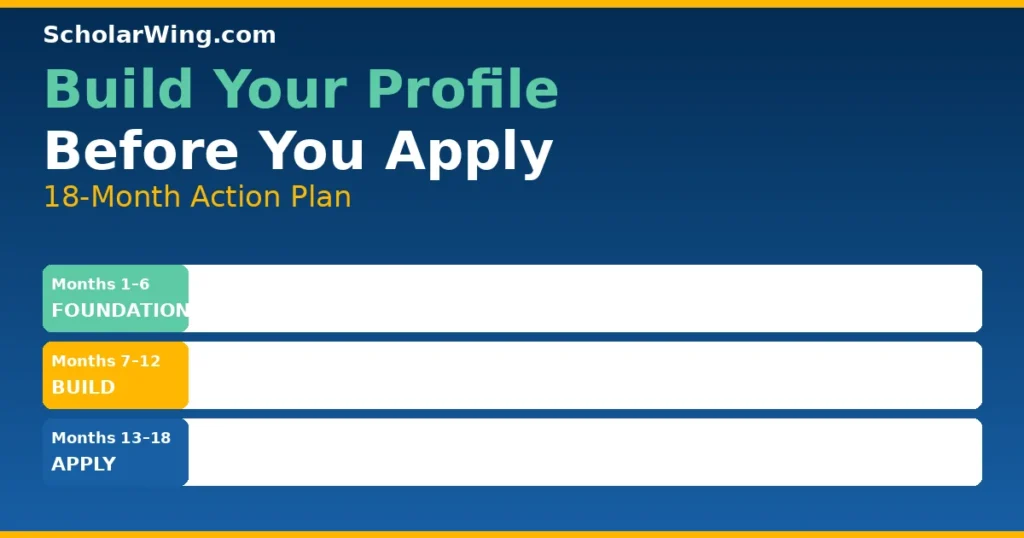
The Strongest Applications Were Built a Year Before Submission — Not the Week Before the Deadline
Most scholarship guides focus on what to write in your application. This one focuses on what to do in the 12-24 months before your application opens, because by the time the portal goes live, the most important decisions have already been made.
The top 1% of Chevening applicants can provide examples of taking the lead and influencing others, with a focus on examples with clear results. Those examples don’t exist because someone thought carefully about how to describe them. They exist because someone spent the previous year doing things that created real, describable results.
If you don’t feel you have enough examples of leadership and influencing skills, Chevening explicitly recommends waiting until a future cycle to apply. That advice applies to every major scholarship, not just Chevening. The profile comes before the application always.
This guide gives you a concrete, actionable 1-2 year plan for building what scholarship committees are actually looking for, organized by scholarship type.
What Scholarship Committees Are Actually Looking For
Before building anything, understand what you’re building toward. Each major scholarship weights its criteria differently:
Chevening (UK): Selection rests on four criteria: leadership and influence, networking ability, a clear career plan showing how the UK degree will help create a positive impact, and the quality of the study proposal. No GPA threshold is published. Chevening is not a traditional academic scholarship, it targets emerging leaders who already have meaningful work experience and demonstrated leadership potential.
Rhodes (Oxford): Intellectual curiosity, character, leadership in non-formal roles, and commitment to service. Programs like Rhodes actively seek exceptional candidates with outstanding academic records and social commitment, your potential matters more than your professional track record.
DAAD: Academic quality, research potential, and clear development relevance. Two years of post-graduation work experience required for EPOS and Leadership for Africa programs.
Mastercard Foundation: Explicitly seeks students from disadvantaged backgrounds with high potential, don’t minimize your challenges, they’re part of your story.
The pattern: Every major scholarship looks for evidence of impact, not evidence of intention. The question is never “what do you plan to do?” It is always “what have you already done, and what does that tell us about what you will do?”
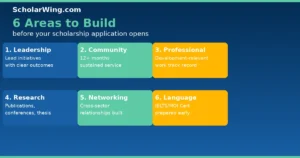
The 6 Areas You Need to Build
Area 1: Leadership Experience — Not Just Job Titles
The most common misunderstanding about scholarship leadership criteria: it is not about your job title or organizational seniority. Chevening values examples of how you brought people together and how your efforts contributed to meaningful change, whether in your organization, community, or beyond.
A mid-level government employee who built a new system that changed how their department operates has more compelling Chevening material than a senior manager who managed a team without initiative.
What to do in the next 12-24 months:
- Identify one specific initiative you can lead — not join, lead. A community project, a workplace reform, a youth program, a policy advocacy effort. The scale matters less than the leadership and results.
- Document outcomes as you go — how many people affected? What changed? What was measured before and after? These numbers are the raw material of compelling scholarship essays.
- Take on visible roles in professional associations, alumni networks, or civil society organizations — these are the “non-formal leadership” positions Rhodes and Chevening value explicitly.
- Build at least 3-5 concrete, describable leadership examples — each one following the STAR format naturally: Situation (what was the problem?), Task (what was your role?), Action (what did you specifically do?), Result (what measurably changed?).
What not to do: Pad your CV with committee memberships where you attended meetings but led nothing. Selection committees can tell the difference. A genuine small initiative with real outcomes outweighs a long list of passive memberships.
Area 2: Community and Civic Engagement
For scholarships like Mastercard Foundation, Rhodes, and Commonwealth, where service is explicitly in the selection criteria, community engagement is not optional background. It is a core qualification.
What counts:
- Sustained volunteer work with a specific organization over 12+ months (not one-off events)
- Founding or significantly growing a community initiative
- Mentoring younger students or professionals with documented impact
- Advocacy work connected to a specific social problem relevant to your country
What to do:
- Choose one organization or cause where you can make a genuine contribution over 12-18 months, not three causes superficially
- Track your involvement: hours, outcomes, people reached
- Connect this work to your proposed area of study, the line between your community work and your academic goals should be clear in your application
Area 3: Professional Track Record and Development Relevance
DAAD’s most competitive programs (EPOS, Leadership for Africa) require a minimum of two years post-graduation work experience. Chevening requires 2,800 hours (roughly two full-time years). Australian Awards strongly prefers applicants with meaningful professional experience.
But the quantity of experience matters less than its development relevance, how directly does your work connect to the challenges your home country faces?
What to do:
- If you’re currently employed, document how your specific work connects to your country’s development priorities, education, health, infrastructure, governance, agriculture, environment. These connections form the backbone of your “return plan” in every scholarship application.
- If you’re not yet at 2 years of experience, plan now: which job or role will you pursue that both advances your career AND builds the development narrative you’ll need?
- Pursue promotions, project leadership, or lateral moves that expand your responsibilities, the scholarship application question is “what have you achieved professionally?” not “what is your job title?”
- Consider whether your employer can support a professional project that creates documented impact, a published report, a policy change, a measurable improvement in service delivery.
Area 4: Academic and Research Credentials
For PhD-focused scholarships (DAAD Research Grants, CSC China PhD, Rhodes, Commonwealth Split-Site), your academic profile matters in a different way than for Master’s scholarships. Publications, conference presentations, and research supervisor letters carry weight that employment history does not.
What to do:
- If you are still in your Master’s or finishing your undergraduate degree, identify research you have done or are doing that could be developed into a paper or conference presentation
- Contact your thesis supervisor about publishing findings in a journal or presenting at a conference, even a regional or national conference is a credible credential
- For CSC China PhD applicants: contact potential Chinese supervisors now, read their recent work, and build the relationship over 3-6 months before your application opens
- For DAAD Research Grants: identify German research groups whose work aligns with yours and begin correspondence with potential supervisors well before the application cycle
For Master’s scholarships, academic credentials are important but secondary to leadership and impact evidence — prioritize Areas 1 and 2 if your time is limited.
Area 5: Professional Networking — Build Before You Need It
Chevening’s selection criteria explicitly includes networking ability, effective leaders are good at building relationships and demonstrating collaboration that led to real, measurable outcomes.
This is not about LinkedIn connection counts. It is about demonstrable professional relationship-building that created outcomes.
What to do:
- Attend industry conferences, policy forums, and professional association events, and follow up with specific people you met, establishing ongoing professional relationships
- Engage with alumni of your target scholarships in your home country, Chevening alumni associations, DAAD alumni chapters, and Fulbright alumni networks are active in many countries. Connect with them now, not after you apply.
- Document collaborations that crossed organizational or sectoral boundaries, Chevening specifically values inter-sectoral relationship building
- Build relationships with senior professionals in your field who could serve as credible referees, the quality of your recommendation letters depends on the quality of these relationships
For the complete guide to requesting strong recommendation letters: Reference Letter Generator
Area 6: Language Preparation — Do It Now, Not in Panic
Every scholarship has language requirements that take time to meet. Starting language preparation 12-18 months before your target application cycle removes one of the most commonly last-minute, expensive scrambles in the entire process.
For IELTS/TOEFL (Chevening, Commonwealth, Fulbright, Australian Awards):
- Target band score 6.5-7.0 for most programs — allow yourself two attempts minimum
- Many test-takers score better on their second attempt after understanding the format
- IELTS results are valid for 2 years — take the test early enough that results are still valid at the time of conditional offer acceptance (typically 8-10 months after the application deadline)
For scholarships accepting a free MOI Certificate (DAAD, CSC China, GKS Korea):
- Get your MOI Certificate before your application cycle opens, it takes one visit to your university registrar
- Free template and format guide: Free MOI Generator
And for German language (some DAAD programs):
- DAAD often funds a preparatory German language course — but a B1 or B2 certificate before applying demonstrates genuine commitment and strengthens your application
- Goethe Institut offers German courses and exams in most countries
What Scholarship Committees Penalize — Or Ignore
Padded CVs with passive memberships: Being “a member of” 12 organizations impresses no one. Selection committees see through this immediately. Reduce the list; deepen the real involvement.
Generic community work without outcomes: “I volunteered at a local charity” without specifying what you did, how long, how many people were affected, and what changed is empty. Track everything.
AI-generated application content: Chevening explicitly prohibits AI-generated answers and uses tools and software to identify fraud, plagiarism, and AI-generated content. If you aren’t confident you can write a competitive application in your own words, they strongly recommend waiting to apply until you can. Build the real experiences that give you real things to write. The writing tools on ScholarWing are for structuring and formatting, the substance must come from you.
Exaggerated or unverifiable claims: Selection committees interview shortlisted applicants. Exaggerations are exposed in interviews. Every claim in your application should survive a 10-minute conversation about it.
Month-by-Month Action Plan (18 Months Out)
| Timeline | Action |
|---|---|
| Month 1-2 | Identify target scholarships. Map their criteria against your current profile. Identify the 2-3 biggest gaps. |
| Month 2-4 | Begin or formalize one leadership initiative. Join one professional association with an active leadership role. |
| Month 3-6 | Take IELTS/TOEFL if required, or get MOI Certificate. Begin German language study if targeting DAAD German-taught programs. |
| Month 4-8 | Build documented community engagement with one organization. Track outcomes monthly. |
| Month 6-10 | Begin networking with target scholarship alumni in your country. Attend one industry conference or policy forum. |
| Month 8-12 | Identify potential referees and begin building those professional relationships. |
| Month 10-14 | Start drafting your core narrative — return plan, leadership examples, development connection. |
| Month 12-16 | Application cycle opens. You now have 12-15 months of documented activity to draw from. |
| Month 14-18 | Submit applications. Request references from people who have observed the specific work you’ve done. |
Profile Assessment: Where Are You Now?
For each area, rate yourself 1-3 (1=weak, 2=developing, 3=strong) and identify the gap you’ll spend the next 12-18 months closing:
Leadership: Can I describe 3-5 specific initiatives I led, with clear outcomes, that I didn’t merely participate in?
Community engagement: Do I have 12+ months of sustained, documented contribution to a specific cause or organization?
Professional track record: Does my work directly connect to my country’s development priorities in a specific, nameable way?
Academic/research: Do I have a publication, conference presentation, or thesis finding I can discuss in depth with a selection committee?
Networking: Have I built professional relationships across sectors that led to measurable collaborations or outcomes?
Language: Am I ready to submit a language test score or MOI Certificate without scrambling?
If you rated yourself 1 or 2 in more than three areas, you have work to do before your application will be competitive for the most selective programs. That’s not a discouragement, it’s a roadmap.
FAQ
How early should I start building my scholarship profile?
18-24 months before your target application deadline is ideal. This gives you enough time to lead a meaningful initiative, build documented community engagement, and have results to describe. Less than 12 months is workable but constraining.
Can I build a competitive profile while working full-time?
Yes, most of what selection committees value (community leadership, professional impact, cross-sector networking) happens within or alongside your working life, not separate from it. The question is whether you are actively building and documenting this work, or simply doing your job and moving on.
What if I haven’t published anything for DAAD PhD?
A publication is not a strict requirement for most DAAD programs. What matters more for PhD applications is a clear, realistic research proposal and a supportive potential supervisor at a German university. Begin correspondence with German professors in your field 6-9 months before the application cycle opens.
Do Mastercard Foundation and similar scholarships really consider disadvantaged backgrounds?
Yes, explicitly. Programs like Mastercard Foundation specifically want to support talented students who face financial barriers and don’t minimize challenges. If financial hardship shaped your educational journey, describe it honestly and specifically, not as an excuse but as context for what you built despite it.
How do I know which gaps to prioritize?
Map your target scholarship’s selection criteria directly against your current documented experience. The largest gaps between what the selection committee is looking for and what you can currently describe with specific, verifiable examples are where your time should go.