
“Can I Bring My Family?” Is One of the Most Common Scholarship Questions — And the Answer Changed in 2026-27
For married applicants, this question often matters as much as the scholarship itself. A fully funded opportunity that requires leaving a spouse and children behind for one to four years is a fundamentally different decision than one that allows the family to travel together.
The honest answer is: it depends entirely on which scholarship, which country, and how long your program is and the rules are not the same across DAAD, Chevening, Commonwealth, and CSC China. One of the biggest changes affecting this decision happened in the UK in the last two years, and most applicants don’t find out about it until after they’ve already applied.
This guide walks through the real rules for the scholarships ScholarWing readers apply to most, what each program actually pays toward family costs (if anything), and what the practical reality looks like once you arrive.

The General Rule Across Almost Every Scholarship
Before getting into country-specific detail, one principle holds true almost everywhere:
Scholarships fund the scholar. They do not automatically fund a spouse or children.
Where family support exists, it is usually:
- Conditional on your program length (commonly a 6-month minimum)
- A separate, smaller allowance — not equivalent to a second full stipend
- Something you must specifically apply for, not something granted automatically
- Subject to your destination country’s separate dependent visa rules, which are not controlled by the scholarship itself
In other words, even scholarships that do support family members are supporting your family’s presence, not necessarily their full cost of living. Budget accordingly — see ScholarWing’s guide on pre-departure and ongoing costs: Hidden Costs Fully Funded Scholarship
DAAD (Germany) — Family Allowance for Programs Over 6 Months
DAAD has one of the clearest and most generous family support policies among major scholarships, but it comes with specific conditions.
The 6-month rule: If your DAAD funding period is less than 6 months, there are no provisions to unite families, and no family allowances can be paid under any circumstances. If your funding period is over 6 months, DAAD may offer family allowances, but conditions vary by specific program, so you must check your program’s individual Call for Applications.
What DAAD pays, if your program qualifies:
- Partner allowance: EUR 276 per month for an accompanying spouse or registered partner
- Child allowance: EUR 259 per month per child (or you can apply for state child benefit if eligible, which may be more)
- Insurance benefits: Health insurance coverage for accompanying spouses, registered partners, and children is included in many programs
Important conditions:
- These allowances are not automatic — you must read the specific Call for Applications for your scholarship category to confirm whether family provisions apply
- Scholars and accompanying family members must have health insurance from day one for the entire duration of their stay in Germany
- The composition of the full benefits package — travel allowance, family allowance, language course — depends on your specific program and country of origin, so don’t rely on “average” figures from generic sources
Visa process: Once your DAAD scholarship confirms family allowance eligibility, your spouse and children apply for a German family reunification visa (Familiennachzug) through the German embassy in your home country, alongside your own student visa application.
For the complete German visa process for DAAD scholars, see: Visa Process After Scholarship
Chevening (UK) — Strongly Discouraged, Not Forbidden
Chevening’s position on this is direct and worth understanding clearly before you apply.
Chevening’s official guidance states you are strongly advised not to bring family members or dependents to the UK, given the high cost of living, because Chevening is unable to offer any financial or immigration support for dependents.
What this means in practice:
- Chevening does not pay any additional allowance for a spouse or children
- Chevening provides no immigration support or guidance specifically for dependent visa applications
- If you choose to bring family anyway, you are entirely responsible for your dependents’ visa costs, accommodation, healthcare, and living expenses
The 2026-27 UK rule change that matters here: As of 2026-27, most master’s and undergraduate international students in the UK can no longer bring dependents on a Student visa at all — this was one of the most significant UK immigration policy changes affecting international students in the past decade.
However — government-sponsored students are excepted. Students on government-sponsored scholarships (including Chevening and Commonwealth) on courses of 6 months or longer remain in the group still eligible to bring dependents under current UK rules. This is a meaningful distinction: a self-funded UK master’s student generally cannot bring a spouse in 2026-27, but a Chevening or Commonwealth scholar technically still can, Chevening simply advises against it due to cost and lack of support.
If you bring family despite the advisory: Your spouse and children would apply for a Student dependent visa, but you carry the full financial burden, with the IHS (Immigration Health Surcharge) and all living costs falling on your scholarship stipend alone, which Chevening explicitly states is not designed or sized for that purpose.
Commonwealth Scholarship (UK) — Allowance Available, With Strong Caveats
Commonwealth Scholarships (administered by the Commonwealth Scholarship Commission, CSC UK) take a more structured approach than Chevening, but with important restrictions.
Family allowances exist, conditionally: If you are a single parent, you may be eligible to claim family allowances while your dependents (spouse and/or children) are in the UK. Eligibility for the allowance does not automatically guarantee a visa will be granted, these are two separate approval processes.
The 18-month guidance: If your scholarship is less than 18 months long, you are specifically advised not to bring your family to the UK, due to the intensity of shorter courses, the high cost of living, and the difficulty of finding suitable family accommodation in that timeframe.
Documentation requirement: If your family does join you, you must complete a Family Record Form once they arrive, providing a UKVI share code for each dependent, proof of entry (boarding pass copies), and confirmation that all family members are staying at the same address for at least three months. This form is submitted to your Program Officer to process any allowance payments.
Visa fees for the scholar: Commonwealth Scholars should select “yes” when asked if they hold a Marshall, Chevening, or Commonwealth Scholarship on their visa application, this typically waives the visa application fee and the Immigration Health Surcharge for the scholar (though not automatically for dependent’s, so confirm current terms).
CSC China — Family Can Join, But at Your Own Expense
China’s approach is the most straightforward to understand: family is allowed, but it is entirely self-funded.
The CSC scholarship does not fund dependent’s in any way. There is no partner allowance, no child allowance, and no insurance coverage for family members under the scholarship itself.
What’s available: Your spouse and children can apply for S1 or S2 dependent visas to join you in China:
- S1 visa — for family members planning a long-term stay (foreign residents’ family members). Valid for up to 180 days, extendable for a further 180 days while in China.
- S2 visa — for family members visiting for a shorter-term stay. Also valid up to 180 days, extendable similarly.
Required documents for S1/S2 applications include:
- Passport with at least 6 months validity and a blank visa page
- Proof of relationship (marriage certificate for spouse, birth certificate for children)
- Invitation or supporting documents from the CSC scholar already in China
Important restrictions:
- Family members on an S1 visa are not permitted to work in China
- Siblings are not eligible for a family visa under this category — only spouse, parents, and children under 18 qualify as immediate family for this purpose
- Visa extensions can be processed in China through the local PSB (Public Security Bureau) Exit-Entry Administration office
Practical reality: Some Chinese universities offer family-friendly accommodation, but typically at an additional cost beyond what the scholarship stipend covers. Budget for this separately, a CSC stipend of CNY 2,500-3,500/month is designed for a single student’s living costs, not a family’s.
For the complete China visa process (X1 visa for the scholar specifically), see: Visa Process After Scholarship
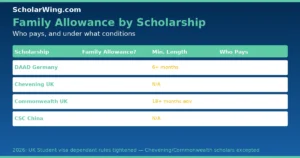
Quick Reference: Family Support by Scholarship
| Scholarship | Family Allowance? | Minimum Program Length | Who Pays Living Costs |
|---|---|---|---|
| DAAD (Germany) | Yes, conditionally | 6+ months for any provision | DAAD allowance + your own funds |
| Chevening (UK) | No | N/A — discouraged regardless of length | Entirely self-funded |
| Commonwealth (UK) | Yes, conditionally | Advised against under 18 months | Allowance (if eligible) + your own funds |
| CSC China | No | N/A | Entirely self-funded |
| Erasmus Mundus | Varies by consortium | Check specific program | Generally self-funded |
| GKS Korea | No standard provision | N/A | Entirely self-funded |
| Turkiye Burslari | No standard provision | N/A | Entirely self-funded |
Always verify current terms directly with your specific scholarship before making any family travel decisions, policies and allowance amounts are reviewed periodically and can change between cycles.
Questions to Ask Before Deciding to Bring Family
1. Does my scholarship explicitly offer a family allowance, or am I covering everything myself? Check your scholarship’s official handbook or Call for Applications directly, don’t rely on general online information, since terms vary by program category even within the same scholarship body.
2. Is my program long enough for the disruption to be worth it? Both DAAD and Commonwealth use 6-18 month guidance thresholds for good reason, short, intensive programs leave little time for family settling-in, schooling logistics, or building a support network.
3. Can my stipend realistically support a family, even with an allowance? A DAAD partner allowance of EUR 276/month plus your own stipend is still a tight budget in most German cities. Run the actual numbers for your specific destination city before committing.
4. What happens to my dependent’s visa status if my program changes or ends early? Dependent visas are typically tied directly to your status as the primary visa holder. If your program is interrupted, extended, or you change institutions, your family’s visa status is affected too, understand this dependency before traveling together.
5. Does my destination country’s separate immigration policy allow it, even if my scholarship does? As the UK’s 2026-27 rule change shows, scholarship policy and immigration policy are two different things. A scholarship can technically allow family, but national immigration rules determine whether a visa is actually issued, always check both.
Practical Tips
1. Get the family allowance terms in writing before accepting your scholarship If family support is a deciding factor in your decision, get explicit written confirmation from your scholarship’s program officer about what specifically applies to your program category, not just general website information.
2. Budget separately for dependant visa costs Visa fees, health insurance, and the Immigration Health Surcharge (for UK) typically apply per dependant, separate from your own scholarship-covered visa process. These add up quickly for a family of three or four.
3. Research schooling options early if bringing children International school costs, public school enrollment eligibility, and language requirements for children vary enormously by country and city — research this before committing to a family relocation, not after arrival.
4. Consider a staged approach Some scholars choose to travel alone initially and bring family later once settled, housing is confirmed, and the realistic monthly budget is clearer. This is a common and practical strategy, particularly for scholarships without guaranteed family allowances.
5. Connect with alumni who brought family on the same scholarship Scholarship alumni networks (particularly active for Chevening and DAAD) often include scholars who made this exact decision. Their first-hand experience is more valuable than any general guide, including this one.
FAQ
Did UK rules for student dependants change in 2026-27?
Yes, most master’s and undergraduate international students in the UK can no longer bring dependents on a Student visa. Government-sponsored scholars (Chevening, Commonwealth) on courses of 6+ months. And most PhD/research route students, remain in the group still permitted to bring dependents.
Does CSC China pay for my spouse or children to join me?
No, CSC does not fund dependents in any way. Your spouse and children can apply for S1 or S2 dependent visas to join you in China, but all costs are entirely your own responsibility.
Can my dependents work while in China or the UK on a dependent visa?
In China, family members on an S1 visa are not permitted to work. UK dependent visa work rights vary by specific visa category and current immigration rules, verify current terms directly with UKVI before assuming work eligibility.
Is it better to bring family from the start, or wait?
This depends on your program length, your scholarship’s specific family provisions, and your personal financial situation. A staged approach, traveling alone first, then bringing family once settled, is a common and practical strategy many scholars use, particularly when family allowances are not guaranteed.