
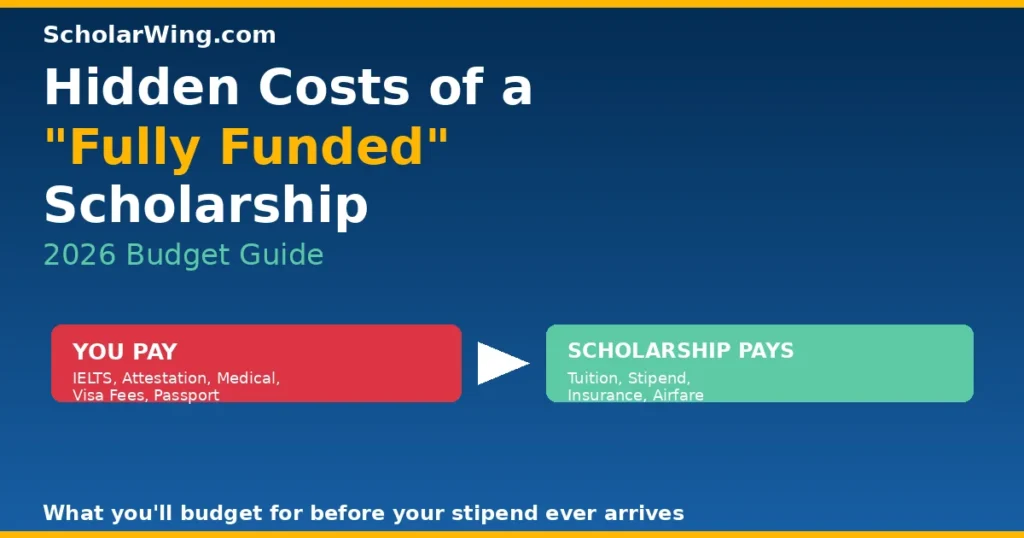
“Fully Funded” Describes the Scholarship — Not Your Bank Account Before It Starts
Every year, thousands of students win prestigious, genuinely fully funded scholarships, DAAD, Chevening, CSC China, Fulbright, GKS Korea, Rhodes, and then discover a gap nobody warned them about. The scholarship covers tuition, your monthly stipend, health insurance, and often airfare. What it doesn’t cover is the 3-6 months before your program starts, during which you are expected to pay for a long list of documents, tests, and processes entirely out of your own pocket.
This is not a criticism of any scholarship program. It’s simply how the timeline works everywhere in the world: your costs come first, your funding comes after you arrive. This guide is an honest, country-agnostic breakdown of what those costs actually are, so you can budget for them in advance rather than being surprised by them after you’ve already won.
The Core Idea: Pre-Departure Costs vs. Post-Arrival Funding
Almost every fully funded scholarship in the world follows the same basic structure. Once you arrive and are enrolled, the scholarship pays for:
- Tuition fees
- Monthly living stipend
- Health/medical insurance
- Often international airfare (though this varies — some pay it upfront, some reimburse after arrival)
- Sometimes a settlement or installation allowance
What it does not typically pay for, and what you need to budget for separately, are the costs of becoming eligible to travel and study in the first place. These costs exist regardless of which country you’re applying from or which scholarship you’ve won, only the specific amounts and requirements change.
Hidden Costs of a Fully Funded Scholarship
1. English Language Testing (IELTS / TOEFL)
This is usually the single largest pre-departure cost for students whose first language isn’t English.
Typical cost: IELTS and TOEFL both generally cost between USD 200-250 per attempt, depending on your country and test centre. If you need to retake the test to hit a required band score, this cost repeats.
How to reduce or eliminate this cost: If you completed your previous degree in English, you likely qualify for a Medium of Instruction (MOI) Certificate instead, a free letter from your university registrar confirming your degree was taught in English. This is accepted by DAAD, CSC China, GKS Korea, and several other major programs in place of IELTS or TOEFL entirely.
Generate the correct MOI Certificate format for free: MOI Generator
A genuine note of caution: be wary of websites advertising “IELTS fee scholarships” or “exam fee waivers”, most of these either don’t pay before the test, require conditions most applicants can’t meet (specific household income thresholds, no prior IELTS attempts), or are simply unreliable. Don’t count on this as your primary cost-reduction strategy. The MOI Certificate is the more reliable and widely accepted path if you’re eligible.
2. Document Attestation and Authentication
Almost every country requires your degree, transcripts, and sometimes secondary school certificates to be officially verified before they’re accepted abroad. This process goes by different names in different countries, apostille, legalization, notarization, or embassy attestation, but the underlying need is universal: your home country’s documents need official certification before another country’s institutions or immigration authorities will trust them.
What this typically involves, regardless of country:
- Verification by the issuing authority (your university, ministry of education, or examination board)
- Certification by your national foreign affairs ministry or equivalent body
- A final step — either an apostille (for the ~125 countries that are members of the 1961 Hague Apostille Convention) or embassy/consulate attestation (for countries that are not Hague members)
Typical cost: This varies enormously by country, ranging from a nominal government fee to significant costs if you use a private attestation service to expedite the process. Budget for both the official fees and, if your timeline is tight, possible “urgent processing” surcharges.
Practical tip: Start this process the moment you receive your offer letter, not when your visa deadline approaches. Attestation chains involve multiple government offices, each with independent processing times.
For a complete walkthrough of this process (with specific guidance for Pakistan, including the new HEC online system), see: Document Attestation Apostille Guide Pakistan
3. Medical Examinations
Several countries — China being the most prominent example for ScholarWing’s audience — require a mandatory medical examination as part of the student visa process, and this is never covered by the scholarship before departure.
What’s typically required:
- General physical examination
- Blood tests
- Chest X-ray (to screen for tuberculosis, required by many countries)
- The exam must usually be conducted at a clinic or hospital specifically recognized by the destination country’s embassy, not just any medical facility
Typical cost: This varies by country but is rarely free. Budget for the exam itself, and potentially a second exam if you arrive and your original results have expired (many countries require results within 6 months of travel) or don’t meet the destination country’s specific format.
For the full China X1 visa medical exam process specifically, see: Visa Process After Scholarship
4. Visa Application Fees and Biometrics
The visa itself has a fee, separate from everything else — and this is true almost everywhere in the world.
Components that typically cost money:
- The visa application fee itself (varies enormously by destination, from very low for some countries to several hundred dollars for others)
- Biometrics appointment fee, if charged separately
- Health surcharge — for example, the UK’s Immigration Health Surcharge (IHS), which is a substantial cost calculated based on your program length, paid as part of the UK student visa application even when your tuition and stipend are fully covered by Chevening or another scholarship
- Travel to a visa application centre, if there isn’t one in your home city, some applicants need to travel internationally just to submit biometrics or attend an interview
Practical tip: Check whether your specific scholarship reimburses visa fees after the fact. Some do (partially or fully); many do not, or only reimburse after you’ve already arrived and submitted receipts.
5. Passport Issuance or Renewal
If your passport doesn’t have enough validity remaining for your full study period, or doesn’t have enough blank visa pages, you’ll need to renew it before you can even begin your visa application.
Practical tip: Check your passport’s expiry date and remaining blank pages the moment you receive your scholarship offer, not when you sit down to apply for your visa. A passport renewal can take weeks in some countries, and this delay compounds with every other step that depends on having a valid passport in hand.
6. Courier, Printing, and Notary Costs
These individually small costs add up across a multi-month application and visa process:
- Courier fees for sending physical documents (degree certificates, attested documents, visa support forms) between your home, your university, government offices, and embassies
- Printing costs for the multiple physical copies most processes require
- Notary fees for affidavits or sworn statements, required by several countries’ visa processes
- Photocopying and passport photo costs (many countries have specific photo specifications that differ from standard passport photos)
None of these costs are large individually, but across a process that can stretch for months and involve dozens of documents, they add up to a real number worth budgeting for.
7. Pre-Departure Health Requirements
Beyond the medical exam required for visa purposes, some scholarships or destination countries require specific vaccinations or health certificates before you can travel, particularly relevant for African, South Asian, and Southeast Asian students traveling to countries with specific entry health requirements.
Practical tip: Check both your destination country’s general entry requirements and any scholarship-specific health documentation (some scholarship programs require a separate medical fitness certificate from your home country physician, distinct from the visa medical exam).
How to Realistically Plan for These Costs
1. Start budgeting the day you receive your offer letter, not when your visa deadline approaches Every cost on this list has its own processing timeline. Bunching them all into the final month before departure creates both financial and logistical stress.
2. Use free tools wherever they exist The MOI Certificate replacing IELTS is the single biggest savings opportunity for most applicants, use it whenever your scholarship accepts it. ScholarWing’s free document generators (SOP, motivation letter, CV, cover letter, reference letter) also remove the cost of hiring paid consultants, which many students spend USD 200-500 on unnecessarily.
3. Check whether your specific scholarship reimburses any pre-departure costs Some programs (particularly government scholarships like Chevening and certain DAAD tracks) reimburse visa fees or provide a settling-in allowance shortly after arrival. Read your offer letter and scholarship handbook carefully, and ask your scholarship’s support office directly if this isn’t clear.
4. Don’t let cost stop you from applying in the first place The costs in this guide are real, but they are also far smaller than the total value of a fully funded scholarship, typically representing a small fraction of what the scholarship itself is worth. Many students assume they can’t afford the pre-departure process and don’t apply at all. If finances are a genuine barrier, look specifically for scholarships with the most accessible pre-departure requirements: Scholarship Without IELTS
5. Ask your scholarship’s alumni network for realistic cost estimates Previous scholars from your country who went through the exact same program recently have the most accurate, current cost information, often more useful than generic online estimates, since costs and exchange rates change.
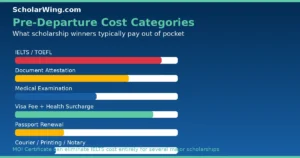
Quick Reference: Pre-Departure Cost Categories
| Cost Category | Can It Be Reduced or Avoided? |
|---|---|
| IELTS/TOEFL | Yes — MOI Certificate accepted by several major scholarships |
| Document attestation/apostille | Partially — some countries now offer online systems that reduce time and travel costs |
| Medical examination | No — generally mandatory where required, but shop for the most affordable approved clinic |
| Visa application fee | No — fixed by destination government, though some scholarships reimburse |
| Health surcharge (e.g., UK IHS) | No — mandatory, but calculate it early so it doesn’t surprise you |
| Passport renewal | Avoidable if checked early — renew before it becomes urgent |
| Courier/printing/notary | Minimizable — batch processes together where possible |
FAQ
Does “fully funded” mean I won’t pay anything at all?
No, “fully funded” refers to your tuition, living stipend, and insurance once your program begins. It does not typically cover the pre-departure costs of becoming eligible to travel: language tests, document attestation, medical exams, and visa fees.
Which scholarships help reduce these pre-departure costs the most?
Scholarships that accept a free MOI Certificate instead of IELTS/TOEFL (such as DAAD, CSC China, and GKS Korea) significantly reduce one of the largest cost categories. Some government scholarships also reimburse visa fees or provide a settling-in allowance shortly after arrival, check your specific program’s policy.
How much should I budget in total for pre-departure costs?
This varies enormously by country, destination, and which costs you can avoid (such as IELTS via MOI Certificate). Rather than relying on a generic global figure, get a personalized list of required steps for your specific scholarship and destination, then research current local costs for each one early in your process.
Can I get any of these costs reimbursed after I arrive?
Some can. Many government scholarships provide a settling-in or installation allowance within the first few weeks of arrival, and some explicitly reimburse visa fees with proper documentation. Always check your offer letter and scholarship handbook, and keep every receipt during the pre-departure process.
What’s the single biggest way to reduce my pre-departure costs?
For most applicants, replacing IELTS/TOEFL with a free MOI Certificate (where your scholarship accepts it) is the largest single saving. Beyond that, using free document-writing tools instead of paid consultants for your SOP, CV, and motivation letter removes another significant and entirely avoidable cost.