
Most Scholarship Guides Tell You to “Apply Early” and “Proofread Your Essay.” This One Doesn’t.
Generic advice exists everywhere. Start early. Check for typos. Follow the instructions. These things are table stakes, every serious applicant already does them.
This guide covers what separates competitive applications from the ones that get rejected, the things scholarship committees at Chevening, Rhodes, DAAD, CSC China, Mastercard Foundation, and GKS Korea have explicitly said they look for, and the practical strategies that change outcomes.
If you’re applying for international scholarships in 2026-2027, this is the guide that will change how you approach the process.
Scholarship Application Tips:
Tip 1: Apply to the Right Scholarships — Not the Most Famous Ones
The most common mistake is applying to the most well-known scholarships, Chevening, Fulbright, Rhodes, while ignoring programs with far better odds for your specific profile.
Ask these questions before adding any scholarship to your list:
- Does my field of study match what this scholarship funds?
- Do I meet the work experience requirements?
- Is my GPA competitive for this program’s typical winners?
- Is my country explicitly eligible, and is it a named priority or a generic inclusion?
A practical example: A student with a 3.2 GPA and no work experience applying to Chevening will not succeed, Chevening requires at least two years of work experience and values demonstrated leadership above academic records. That same student applying to GKS Korea (minimum 2.64/4.0, no work experience required) or CSC China (no minimum GPA) has a genuine shot.
Fit matters more than prestige. Apply to programs where you’re a strong match, not programs where a lucky outcome would be required.
Use ScholarWing’s free tools to identify which programs match your profile:
- Scholarships Without IELTS — if IELTS is a barrier
- Low GPA Scholarships — if your GPA is below 3.5
Tip 2: Get a Free MOI Certificate Instead of Spending on IELTS
This is one of the most practical money-saving strategies available to international students — and most applicants don’t know it exists.
A Medium of Instruction (MOI) Certificate is a letter from your university registrar confirming that your degree was taught in English. It is accepted in place of IELTS by DAAD (Germany), CSC China, GKS Korea (South Korea), and several other major scholarship programs.
Programs that accept MOI Certificate instead of IELTS:
- DAAD Germany — explicitly accepts MOI Certificate for English-medium programs
- CSC China — MOI Certificate accepted for English-taught programs
- GKS Korea — MOI Certificate or no test required
- Stipendium Hungaricum — varies by program but often accepts MOI
How to get it:
- Visit your university’s registrar or academic records office
- Request an “English Medium of Instruction Certificate” on university letterhead
- Ask for it to be signed and stamped by the registrar
- Use ScholarWing’s free MOI Generator for the correct format template
Cost: Free (or a small administrative fee at your university). IELTS costs USD 200-250 per attempt. If you’re applying to 4-5 programs, this saves USD 800-1,000.
Tip 3: Write a Specific Return Plan — Not a Generic One
This is the single biggest differentiator between competitive and non-competitive applications.
Scholarship committees can distinguish between performative statements and authentic commitment. What have you actually done that improved someone’s life? Be specific.
Every unsuccessful applicant writes something like: “After completing my degree, I will return to my country and use my knowledge to contribute to national development.”
This sentence says nothing. It names no specific role, no specific organization, no specific problem, no specific community. Every applicant writes it. It is filtered out immediately.
What a specific return plan looks like:
Weak: “I will return to Pakistan and work in the education sector to improve literacy rates.”
Strong: “I will return to Lahore within two years and join the Punjab Education Foundation as a curriculum specialist, where I will apply my research in early childhood cognitive development to reform the Grade 1-3 Urdu literacy curriculum currently used in 7,000 partner schools. This directly addresses the 23% Grade 3 dropout rate documented in the 2024 AEF Progress Report.”
The strong version names: a city, an organization, a role, a specific program, a measurable outcome, and a cited problem. It is verifiable, specific, and credible.
The 4-part formula for a strong return plan:
- Where — specific city, region, or institution
- What role — specific job title or organizational function
- Which problem — named, documented development challenge
- Measurable impact — what you will change and how
Tip 4: Contact Professors Before You Apply (For DAAD PhD and CSC China)
For PhD programs at DAAD and CSC China, a prior contact with your potential supervisor is not optional — it is the difference between acceptance and rejection.
For DAAD PhD: German professors have significant influence over PhD admissions. A professor who knows your research proposal and is willing to supervise you will advocate for your admission. Without this, your DAAD PhD application is much weaker.
For CSC China: A letter of acceptance from a Chinese professor — or at minimum a willingness email — significantly strengthens your CSC application at the university selection stage.
How to contact professors effectively:
- Find 3-5 professors whose published research aligns directly with your proposed study
- Read one of their recent papers (last 2-3 years)
- Write a short email (200-300 words maximum) that:
- Names the specific paper you read
- Explains why your research connects to theirs
- Asks if they have capacity to supervise and if your profile fits their lab
- Follow up once after 2 weeks if no response
Use ScholarWing’s free cold email template: Professor Email Template
When to start: 3-4 months before the scholarship application deadline.
Tip 5: Apply to 3-5 Scholarships Simultaneously — Not One at a Time
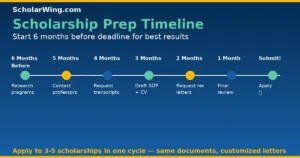
Most students apply to one scholarship at a time. They spend months preparing for Chevening, get rejected, spend months on DAAD, get rejected, and years pass.
The correct strategy is to build your core document set once and customize for multiple programs simultaneously.
Your core document set:
- Academic CV (2 pages)
- Official transcripts and degree certificate
- MOI Certificate or IELTS score
- 2-3 recommendation letter providers (asked in advance)
- Draft SOP / motivation letter (base version)
How customization works: Once you have these, customizing for each scholarship takes 3-4 hours per application, not weeks. The base motivation letter needs:
- Different opening (addressing the specific scholarship’s values)
- Different return plan framing (matching what the scholarship funds)
- Different closing (acknowledging the scholarship’s specific mission)
Programs with overlapping application timelines:
| Scholarship | Deadline | Core Documents |
|---|---|---|
| DAAD | Oct–Jan | Same CV, SOP base |
| Chevening | Nov 5 | Same CV, SOP base |
| Erasmus Mundus | Nov–Jan | Same CV, SOP base |
| Rhodes/Commonwealth | Aug–Nov | Same CV, SOP base |
| CSC China | Feb–May | Same CV, SOP base |
Apply to 3-5 programs in the same cycle. Your odds multiply without your workload multiplying proportionally.
Tip 6: Request Recommendation Letters 6-8 Weeks Before Deadline
This is the most common logistical failure in scholarship applications. Students request recommendation letters 2-3 weeks before the deadline. Their recommenders are busy. Letters arrive late or are rushed. The application suffers.
Best practice:
- Identify your recommenders 3-4 months before the deadline
- Send a formal email explaining the scholarship, the deadline, and what you need
- Provide them with: your CV, your draft SOP, a summary of the scholarship’s criteria, and bullet points of things you’d like them to highlight
- Set a reminder: follow up 4 weeks before the deadline, then again 2 weeks before
Who to ask:
- A professor who supervised your thesis or major project
- A direct workplace supervisor (required for Chevening, DAAD EPOS, Fulbright)
- A senior academic or professional who has observed your leadership
What scholarship committees look for in references:
- Committees tend to be dubious of appraisals that imply a given individual has no limitations. A strong reference letter speaks to both strengths and honest limitations — this reads as credible and genuine.
- Specific examples of performance, not general praise
- Evidence of leadership in concrete situations
Use ScholarWing’s free Reference Letter Generator
Tip 7: Write a Different SOP for Every Scholarship
One SOP sent to every scholarship is the second most common reason applications fail. Every scholarship has different values, different selection criteria, and different concepts of what an ideal candidate looks like.
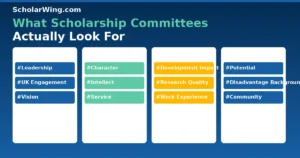
What each major scholarship values:
| Scholarship | Primary Value | Secondary Value |
|---|---|---|
| Chevening | Leadership potential | UK-specific engagement |
| Rhodes | Academic excellence + character | Service to others |
| DAAD | Development relevance | Research quality |
| Fulbright | Cultural exchange | Academic achievement |
| Mastercard Foundation | Potential from disadvantage | Community commitment |
| CSC China | Academic fit | Bilateral development |
| GKS Korea | Academic record | Korean cultural interest |
A Chevening SOP should spend significantly more time on your leadership narrative and your specific vision for what you will do with UK connections. A DAAD SOP should anchor everything in development impact and research quality. A Mastercard Foundation essay should speak directly to overcoming disadvantage and community service.
The same generic SOP sent to all three will not succeed with any of them.
Use ScholarWing’s free SOP Generator to create customized SOPs
Tip 8: Know What You’re Getting Into Before You Apply to Chevening
Chevening is frequently the first scholarship developing country students apply for, and frequently the first rejection they receive. This is because Chevening’s actual requirements are misunderstood.
What Chevening actually requires:
- At least 2,800 hours of work experience after graduating, roughly two years of full-time work
- You must apply to three different eligible UK university courses and have an unconditional offer from at least one by July 9, 2026
- Your application is assessed by an independent reading committee who create a longlist, if longlisted, you are invited to submit references and attend an interview
- IELTS 6.5 minimum
- A clear commitment to return to your home country for two years
What Chevening does NOT primarily select for:
- The highest GPA
- The most prestigious undergraduate institution
- The most technical research proposal
Chevening selects for leadership potential and UK engagement. If you cannot articulate specific ways you have led, influenced, or built something, and specific ways a UK network will advance your future work, a Chevening application will struggle.
If you meet all criteria, apply. And if you don’t have two years of work experience yet, apply to DAAD, CSC China, GKS Korea, or Erasmus Mundus instead and come back to Chevening once you do.
Tip 9: Address Low GPA or Academic Gaps — Don’t Ignore Them
Many students with GPAs below 3.0 or academic gaps either don’t apply at all, or submit applications that ignore these issues entirely. Both approaches fail.
If your GPA is lower than ideal:
First, check whether the scholarship even has a GPA minimum. CSC China has none. GKS Korea requires just 2.64/4.0. DAAD EPOS requires meeting German university admissions requirements, which varies by field.
If your GPA is low for a competitive program:
- Acknowledge it briefly and directly in your SOP
- Explain the specific circumstances (medical, financial, family) if they are real and relevant
- Pivot immediately to what you have achieved since graduation
- Let your research outputs, professional experience, or recommendations speak for your actual ability
One honest sentence explaining a gap is far stronger than a committee noticing it and finding no explanation.
Scholarships with the most accessible GPA requirements:
- CSC China — no published minimum
- GKS Korea — 2.64/4.0 minimum
- Turkiye Burslari — 75% equivalent
- Stipendium Hungaricum — varies by program
Tip 10: Understand the Interview Before You Get There
Three major scholarships require in-person or online interviews: Chevening, Rhodes, and Turkiye Burslari. Most applicants prepare for interviews by reviewing their SOP. This is insufficient.
Chevening interview:
- A panel will ask questions about your personal and professional goals and how a Chevening Scholarship would help you achieve them
- Common questions: Why UK? Why this field? What will you bring back? Give an example of leadership under pressure.
- Prepare with a specific STAR format answer (Situation, Task, Action, Result) for 4-5 leadership examples
Rhodes interview:
- The committee values leadership in less formal roles such as organizing community action, conducting research, or lobbying for policy changes, not just formal elected positions
- Expect questions about your intellectual passions, your character, and what Oxford specifically offers that you cannot get elsewhere
- Know your research area deeply, expect pushback and debate
Turkiye Burslari interview:
- Conducted online, often in English
- Focus on your study plan for Turkey, your motivation to study there specifically, and your return plan
- Know 2-3 specific things about Turkish universities and programs in your field
Tip 11: Use Free Document Tools — Not Paid Consultants
Paid scholarship consultants in Pakistan, Ghana, Nigeria, and other countries often charge USD 200-500 to write SOPs, CVs, and cover letters. This is money most students cannot afford, and the output is frequently generic.
ScholarWing provides free AI-powered generators for every document most scholarships require:
- Statement of Purpose
- Motivation Letter
- MOI Certificate
- Cover Letter
- CV Builder
- Reference Letter
- Personal Statement
- Research Proposal
All tools are free. No login required. No payment.
Tip 12: Apply Again After Rejection — With Specific Changes
Most scholarships allow re-application. Most rejected applicants never apply again, or apply again with the same materials.
The correct approach after rejection:
- Request feedback if possible — Chevening and some other programs provide written feedback to unsuccessful applicants. Use it.
- Identify the specific weakness — Was your return plan too vague? Did you lack work experience? Was your English score too low?
- Address it directly before reapplying — Gain the work experience. Improve the return plan specificity. Strengthen the references.
- Apply to more programs in the same cycle — One rejection in the same year while succeeding elsewhere is a better outcome than one rejection and a year of waiting.
Rejection is not disqualification. It is information.
Quick Reference: Scholarships by Profile
| Your Profile | Best Scholarship Matches |
|---|---|
| Fresh graduate, no work exp | CSC China, GKS Korea, Erasmus Mundus |
| Low GPA (below 3.0) | CSC China, GKS Korea, Turkiye Burslari |
| 2+ years work experience | Chevening, DAAD EPOS, Fulbright, Commonwealth |
| Research / PhD focus | DAAD, Fulbright, Rhodes, CSC China |
| No IELTS / no money for IELTS | DAAD (MOI), CSC (MOI), GKS Korea, Turkiye Burslari |
| Strong French language | Eiffel France, CFSP Canada, Sciences Po |
| Engineering / STEM | DAAD, MEXT Japan, CSC China, GKS Korea |
| Public policy / governance | Chevening, Rhodes, Mastercard Foundation |
FAQ
How early should I start preparing for a scholarship application?
For programs with October-November deadlines (DAAD, Chevening), start in June-July. For August deadlines (Rhodes), start when applications open, don’t wait. Start in November-December, for CSC China (February-May). Contact professors and recommenders 3-4 months before any deadline.
Can I apply to multiple scholarships in the same year?
Yes, and you should. Building your core document set once and customizing for 3-5 programs is the most effective strategy. Most scholarships do not require exclusivity.
Do I need IELTS for international scholarships?
Not for all programs. DAAD Germany, CSC China, and GKS Korea accept a free MOI Certificate. Turkiye Burslari and some Stipendium Hungaricum programs require no English test at all.
What is the most common reason scholarship applications fail?
A vague return plan. “I will contribute to my country’s development” says nothing. A specific, named organization, role, problem, and measurable impact is what committees want to see.
Is it worth applying to the same scholarship after rejection?
Yes, many scholars were rejected once or twice before winning. Request feedback where available, address the specific weakness, and apply again with stronger materials.
What is the difference between an SOP and a motivation letter?
An SOP (Statement of Purpose) is primarily used for academic programs and focuses on your research background, academic goals, and fit with the program. A motivation letter is broader and focuses on your personal motivation, career goals, and why you deserve this scholarship. Most scholarships ask for one or the other, check the requirements carefully.