

South Korea is one of the most underrated study destinations for students from Pakistan, India, Bangladesh, and across Asia and Africa. Most applicants focus on Germany, the UK, or the US — and the result is that Korean scholarship pools are significantly less competitive than European ones.
The GKS scholarship requires a minimum GPA of 2.64 out of 4.0. That is lower than almost any other major government scholarship. It does not require IELTS. It does not require GRE. The monthly stipend is around 700 USD. Tuition is fully waived. The one-year Korean language course is free.
For a student from a developing country who wants a fully funded degree at a world-class university without the IELTS barrier, Korea is one of the strongest options available in 2026-27.
Why Korea
Korea’s universities have climbed faster in global rankings over the past 20 years than almost any other country. KAIST is ranked in the world’s top 50 for engineering. POSTECH is ranked in the top 100 globally and top 10 in Asia for materials science and semiconductor research. Seoul National University is a comprehensive research university with strong faculties across every field.
Beyond academia, Korea’s industry environment is exceptional for technology students. Samsung, LG, SK Hynix, Hyundai, Kakao, and NAVER all have active research partnerships with Korean universities. Students at KAIST and POSTECH work alongside researchers who are employed by these companies. That proximity to industry during graduate study is difficult to find anywhere else.
Korean universities also have large English-medium graduate programs — particularly at KAIST, POSTECH, Yonsei, and Korea University. A Master’s or PhD in computer science, electrical engineering, or materials science at any of these can be completed entirely in English.
Top Scholarships to Study in Korea for Free
1. GKS — Global Korea Scholarship
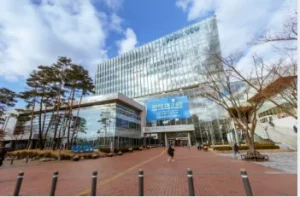
The GKS is administered by NIIED, Korea’s National Institute for International Education, and it is the main vehicle through which international students receive fully funded education in Korea.
What it covers: Full tuition, monthly stipend of KRW 900,000 to 1,000,000 (approximately 680–750 USD), one year of free Korean language training, round-trip airfare, settlement and medical allowances.
Two application tracks:
The Embassy Track is the one most international students use. You apply through the Korean Embassy in your home country. The embassy reviews applications, conducts its own selection, and forwards candidates to NIIED. Most countries have a quota — check with your local Korean Embassy for Pakistan, India, or your country’s allocation.
The University Track is less used and often more effective. You apply directly to a Korean university that has GKS quota. The university evaluates your application and nominates you to NIIED. This track gives you more control over where you end up.
Eligibility: Under 40, minimum GPA of 2.64/4.0, no IELTS required, MOI Certificate accepted for English-medium programs, no GRE required.
Timeline: Embassy applications typically open January–February and close in March. University track deadlines vary.
Deadline: February–March 2027 (Embassy Track)
2. KAIST Scholarships
KAIST — Korea Advanced Institute of Science and Technology — is one of Asia’s top engineering and science universities, and it has its own institutional scholarship program for international graduate students separate from GKS.
Most KAIST graduate students receive funding through one of two routes: the KAIST International Student Scholarship, which covers tuition and provides a monthly stipend, or research assistantship funding from their supervisor’s grants, which can add another 500,000 to 1,000,000 KRW per month on top of the institutional award.
The key to KAIST funding is contacting a professor before applying. KAIST professors have research grants from KAIST, the Korean government (NRF grants), and industry partnerships. When a professor agrees to supervise you, your funding package is typically settled at the offer stage.
Fields where KAIST has exceptional research funding: AI and machine learning, semiconductor engineering, biotechnology, aerospace, robotics, and materials science.
Deadline: September–October 2026 for Spring 2027 entry
3. POSTECH Scholarships
POSTECH in Pohang is Korea’s most research-intensive university — it has a small student population but an unusually high ratio of research funding per student. The university’s partnership with POSCO (one of the world’s largest steel companies) means materials science, chemical engineering, and manufacturing engineering students have direct industry funding.
POSTECH’s Research Scholarship covers full tuition and provides monthly stipends of 300,000 to 500,000 KRW on top of research assistantship income from supervisors. Most funded PhD students at POSTECH earn 1,000,000 to 1,500,000 KRW per month in total.
Contact a POSTECH professor before applying. Like KAIST, funding at POSTECH is supervisor-dependent.
4. Seoul National University Scholarships

Seoul National University (SNU) is Korea’s highest-ranked comprehensive university — strong across sciences, engineering, social sciences, law, medicine, and humanities.
SNU’s international scholarship programs include: the SNU Presidential Fellowship for top incoming international PhD students, the Excellent Research Scholarship for graduate students with strong academic records, and department-level research assistantships.
GKS University Track places a significant number of students at SNU each year — it is one of the most popular partner universities in the GKS system.
5. Yonsei and Korea University Scholarships
Yonsei and Korea University — known together with SNU as the “SKY universities” — both offer international scholarship programs for graduate students.
Yonsei’s International Graduate Scholarship covers partial to full tuition depending on academic merit. Korea University’s Graduate School Scholarship operates similarly. Both universities are in Seoul, have large English-medium graduate programs, and are well-funded by research grants.
Both are accessible via GKS University Track as well.
Korean Language — What You Actually Need
Most people assume learning Korean is mandatory to study there. It is not mandatory — but the situation is more nuanced than a simple yes or no.
For GKS scholars, a one-year Korean language course is mandatory before your degree program starts. By the time you begin your Master’s or PhD, you will have basic-to-intermediate Korean. Whether you use it depends on your program — engineering and science programs at KAIST, POSTECH, and UNIST are taught almost entirely in English. Social science and humanities programs at Seoul-based universities may have more Korean content.
For self-funded or scholarship-funded students at KAIST or POSTECH specifically, Korean language knowledge is not required at all. These universities function largely in English at the graduate level.
Basic Korean for daily life is worth learning regardless — it makes grocery shopping, transport, and social life significantly easier.
How to Apply for GKS — Step by Step
The GKS process is more document-heavy than most scholarships. Getting the documents wrong is the most common reason applications fail before they are even evaluated.
Step 1: Contact the Korean Embassy Get the application package from your local Korean Embassy. Do not rely on old documents downloaded from the internet — requirements change annually. In Pakistan, contact the Korean Embassy in Islamabad.
Step 2: Prepare your documents Required for most GKS applications: completed NIIED application form, personal statement, study plan, two letters of recommendation, degree certificates and transcripts, language proficiency document (IELTS or MOI Certificate), medical examination form (NIIED standard form), passport copy.
Step 3: Write your study plan The study plan for GKS should be specific. Name the Korean university you want to attend, Name the program, Name a professor whose research connects to yours if applying for a research program. Explain what specific knowledge or skills you will gain and what you will do with them after returning home.
Step 4: Submit through the Embassy Embassy Track applications are submitted physically or via the Embassy portal — confirm the submission method with your local Korean Embassy.
Step 5: Interview Shortlisted candidates are typically interviewed at the Korean Embassy. Interviews are conversational — your research plan, reasons for choosing Korea, and return plans.
IELTS Requirements for Korean Scholarships
GKS does not require IELTS. KAIST requires IELTS 6.5 or TOEFL 90 for English-medium programs, or a KAIST English proficiency test. POSTECH requires IELTS 6.5 or equivalent. Seoul National University varies by program — check the specific department.
If your previous degree was taught in English, a MOI Certificate from your university is accepted in place of IELTS for GKS applications.
Use our Free MOI Certificate Generator to generate the correct certificate text before taking it to your registrar.
Free Tools for Your Application
- Free SOP Generator — GKS personal statement and study plan
- Free MOI Certificate Generator — For GKS without IELTS
- Free CV Builder — Academic CV
- Free Research Proposal Generator — For PhD applicants
- Free Reference Letter Generator — For academic references
- Free IELTS and TOEFL Practice — For KAIST and SNU English requirements
FAQ
Can Pakistani students apply for GKS?
Yes. Pakistan is an eligible country for GKS. Apply through the Korean Embassy in Islamabad. The annual quota varies — the Embassy will tell you how many places are available for the current cycle.
Does GKS require IELTS?
No. MOI Certificate from an English-medium university is accepted. You do not need to sit IELTS for the scholarship application itself, though some Korean universities may have their own English requirements for the program.
How competitive is GKS?
It depends on your country’s quota and your field. Countries with larger quotas and fewer applications are less competitive. STEM fields are typically more competitive than humanities and social sciences in Korea.
What is the monthly stipend for GKS?
900,000 to 1,000,000 KRW per month — approximately 680 to 750 USD. This is enough to live comfortably in most Korean cities outside Seoul.
Do I need to know Korean before applying?
No. GKS includes a mandatory one-year Korean language course before your degree program. You arrive with zero Korean and complete the language year before starting your Master’s or PhD.